
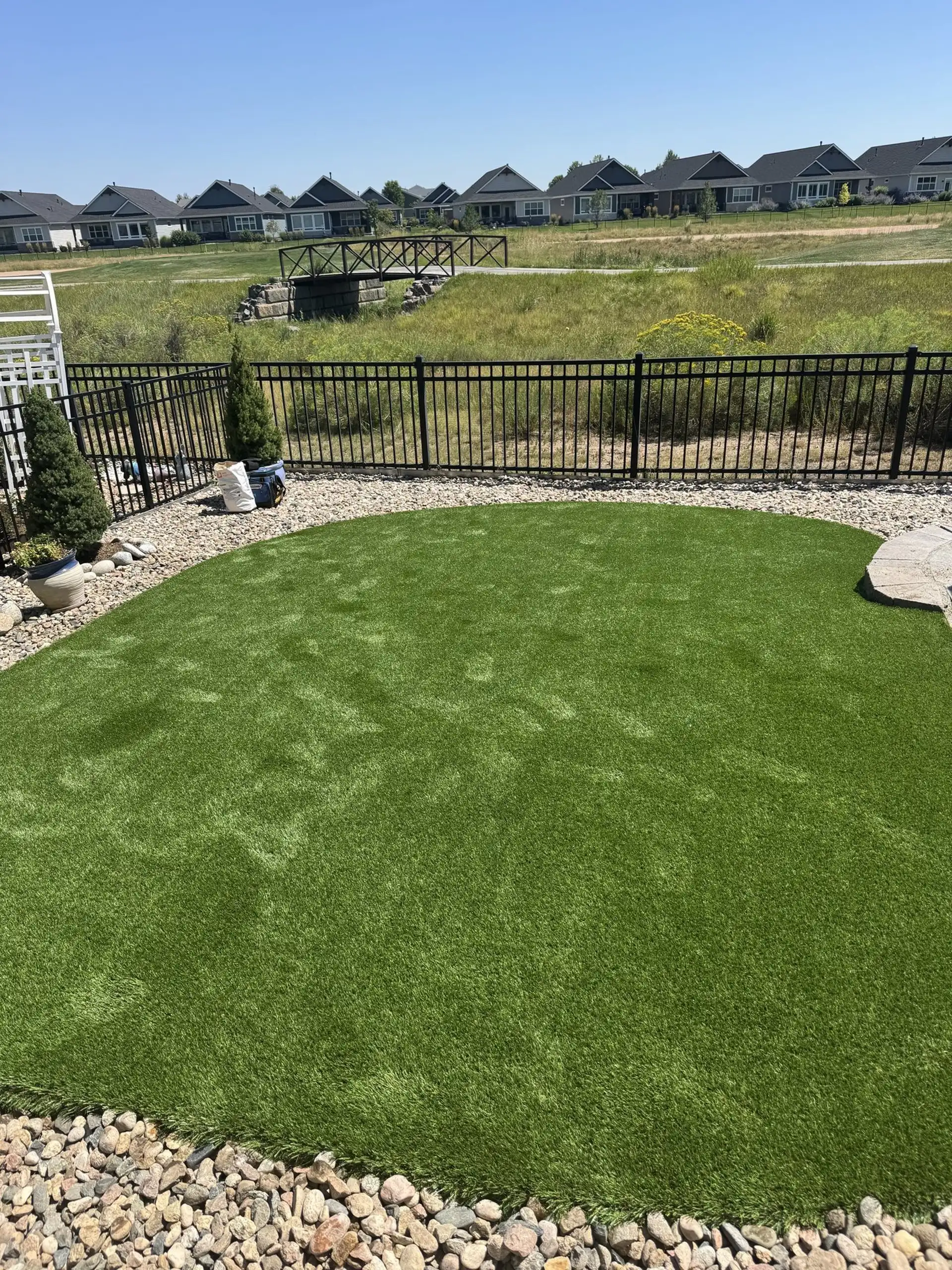
Northeast Florida
Turf replacement in northeast Florida, built to Florida's 2026 rule.
Swap a puddling, split-seam or storm-damaged lawn for turf built to the 2026 standard. We check the surface, edges and drainage at a free visit, then give a written price.
- Infill and base chosen to the 2026 turf rule
- Flood-zone permits checked before the base is dug
- Old turf hauled away, not left at the curb
- Layout approved before installation
- American-made turf
- Free estimates, no pressure
The short answer
Does replacement artificial turf in Florida have to meet the new rule?
Yes, on a single-family lot of an acre or less. Old turf can stay, but a replacement is a new installation: natural infill, a washed stone base, and every edge and seam anchored against wind or flooding.
Before you install
What to know before you start.
The rules in short. We measure and check the ground at a free visit, then draw a layout that fits.
-
The rule and your replacement
On a single-family lot of an acre or less, the new lawn must meet the state rule, so plan on rubber infill leaving with the old turf. Reusing the base? Ask your building office.
See the rule on the rule and your replacement
Keep the old lawn if you like. Build the new one to the rule.
DEP’s synthetic turf FAQ says the rule doesn’t require homeowners to remove existing synthetic turf. Once yours comes out, the new lawn is a new installation. On a single-family lot of one acre or less, Rule 62-308.100 is the minimum it has to meet, and turf that meets it has the protection of section 125.572 against a city or county ban.
Infill is the line most likely to change. The rule allows clean silica sand, rock, shell or other natural material, or silica sand with a non-toxic coating. Rubber or any other synthetic infill is allowed only within the footprint of playground equipment. If your old lawn holds rubber or plastic beads, plan for that infill to leave with the turf instead of going back in. The installation also has to be designed to keep infill on your property.
The base comes next. The rule calls for natural subgrade, such as crushed rock or crushed concrete, washed before installation so fines don’t bind, over soil that isn’t compacted to the point it hurts percolation. It doesn’t say how that applies to stone already in the ground. If you hope to reuse a base, ask your city or county building office how it reads that line. Our Florida turf infill guide covers the full standard.
-
Sand and standing water
Before the old turf comes up, photograph standing water, open seams and lifted edges, since those marks shape the new scope. The new lawn can't pool or add runoff onto the lots next door.
See the rule on sand and standing water
Learn why the old lawn failed before the new one goes down.
Most mapped ground in Duval, St. Johns and Nassau counties is poorly or very poorly drained, according to the USDA figures in our Florida turf guide, and the Jacksonville page describes the wet sand under Mandarin yards. Before the old turf comes up, photograph where water stands after rain, where seams have opened and where edges have lifted. Our list of signs of a bad install shows what else to note.
Those marks shape the new scope. The rule wants the lawn over a base graded for positive drainage, with no pooling and no added runoff onto the lots next door, and water sent to pervious ground on your own lot where possible. Turf also can’t sit in a swale, ditch or stormwater pond. If the old lawn crossed any of those lines, the new layout has to change.
At the free visit we check the surface, edges and drainage. Part of the base only shows once the turf is off, so agree in writing how anything found underneath will be priced and approved before work goes on.
-
Hurricanes and flood zones
In a flood zone, rebuilding a washed-out base can count as development that needs a permit first. Neither Clay nor St. Johns County says whether a turf base alone does, so ask the floodplain office.
See the rule on hurricanes and flood zones
After a storm, check the flood zone before the base is rebuilt.
Storm damage can reach below the turf. Rebuilding a washed-out base can mean excavation, grading or fill, which flood rules treat as development. Clay County says Ordinance 87-45 requires a permit before any development in a Special Flood Hazard Area begins, and lists filling, grading and excavation as development. St. Johns County’s floodplain office says any development in the floodplain needs a construction permit, and the county’s code definitions count filling, grading and excavations as development.
Neither county says whether replacing a turf base, by itself, needs that permit. Ask the floodplain office with your address before work starts. In Duval and Nassau counties, ask the office that issues building permits for your parcel. Our Middleburg, Hibernia and Butler Beach pages cover creek, river and coastal flood rules.
Then build for the next storm. The rule requires turf installed to the manufacturer’s specifications and anchored at all edges and seams so it will, at a minimum, withstand wind or flooding. Ask how each edge and seam will be held down, and how the infill will stay on your lot.
-
Where the old turf goes
Old turf isn't curbside trash — Jacksonville, Clay, Nassau and St. Johns counties all send contractor debris to specific drop-off sites, some with a fee. Put removal, haul-away and disposal in the written scope.
See the rule on where the old turf goes
Old turf isn’t curbside trash. Put haul-away in the scope.
Florida’s definition of construction and demolition debris lists materials such as steel, brick, concrete, pipe and lumber from building or renovation work. It doesn’t name artificial turf, and none of the county sources below does either.
In Duval, Jacksonville’s Section 380.207 says city garbage service isn’t responsible for building material, dirt or rock that results from a contractor’s work. Section 380.302 sends solid waste only to sites the city’s solid waste director designates, and the director sets what each city site accepts.
In Clay, bulk pickup excludes construction and remodeling debris, carpet and flooring included, and the county’s bulk waste page says remodeling businesses are responsible for their own waste. All business waste goes to the Rosemary Hill Solid Waste Management Facility in Green Cove Springs, where disposal fees apply.
In Nassau, the county’s Convenience Recycling Center in Callahan doesn’t accept residential construction and demolition debris such as carpet and remodeling material, and points residents to a private recycling center in Yulee that charges a fee. In St. Johns, the county doesn’t collect that debris curbside and requires residents and businesses to take it to one of two listed disposal sites.
So check that the written scope covers removal, haul-away and disposal of the turf, backing and infill. The new lawn has a disposal line of its own: the rule requires turf, backing and infill that can be disposed of under normal conditions at any Florida landfill permitted under Chapter 62-701. See turf replacement for the full job, and the northeast Florida page for everything else we install here.
What we install
Turf replacement for your space.
FAQ
Questions about turf replacement in Northeast Florida.
Can storm-torn turf go out with hurricane debris?
St. Johns County’s storm debris guidance asks you to separate vegetation from other storm debris, such as construction debris and appliances, and to pile it at least three feet from mailboxes, poles and hydrants. It doesn’t name turf. Ask the county’s solid waste division which pile a torn lawn belongs in.
Who checks that the new lawn meets the rule?
Not the state. DEP says it runs no permitting, inspection or enforcement program under the rule, and it sends local permitting questions to your city or county. Keep the product specifications and a note of the infill and base materials in case a local office or your association asks.
Can I take the old turf to the county myself?
In Clay County, the county lists one level pickup-truck load at an Environmental Convenience Center, or up to 500 pounds a month at Rosemary Hill for households on county garbage service, as no-charge options for debris bulk pickup won’t take. Nassau’s center turns residential construction debris away. In St. Johns, it goes to one of the listed sites. None of them names turf, so ask first.
What helps you price a replacement?
Photos of the lawn after heavy rain and of any storm damage, records from the original installation, your flood zone, and your HOA or CDD rules. If you know what infill the old lawn has, tell us. We measure, check the ground and draw a custom layout you approve before work starts.
Free estimate
See the plan before you decide.
Tell us about your project and we’ll call to arrange a free visit.
Or call 303-349-2368
Your free estimate includes
- A visit to measure your space
- A custom layout, drawn for your space
- Turf options, side by side
- A written price, with no pressure to sign
Five short steps. We’ll call to arrange your visit.