
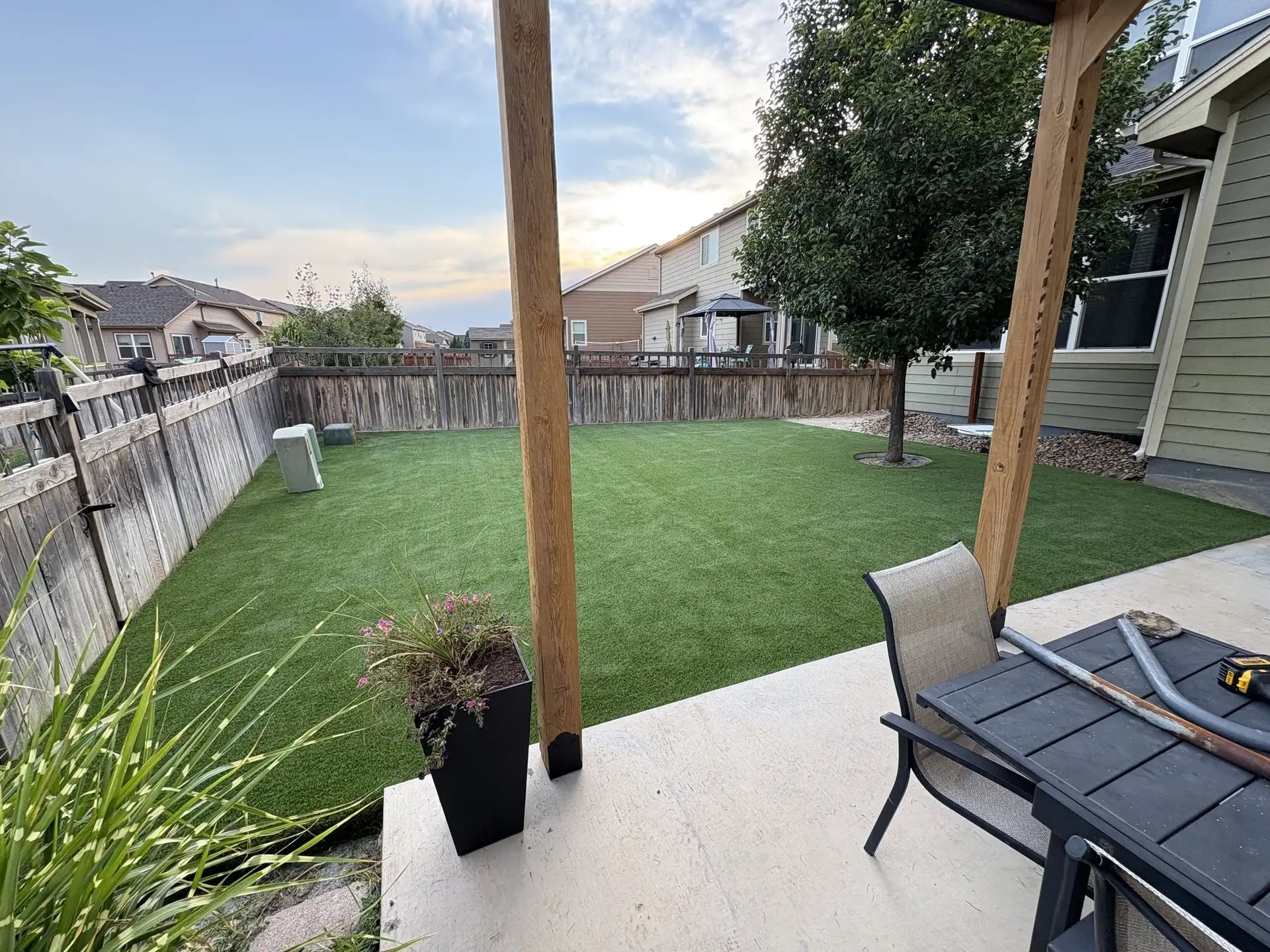
Nassauville, FL
Artificial turf in Nassauville, FL, planned around your septic reserve and the marsh.
Amelia Island's courses are a short drive away, and the room to practice is behind your own house. Free visit, then a written price.
- Choose putting and chipping space with a purpose
- Keep septic and waterfront access available
- Include the actual grade and wet areas
- Layout approved before installation
- American-made turf
- Free estimates, no pressure
The short answer
What should I check before choosing a Nassauville putting-green location?
Where the septic system and well sit. State rules reserve unobstructed ground beside the drainfield and set it back from wells and water, so the green goes in what's left. Check your flood zone and the marsh buffer too.
Before you install in Nassauville
What to know in Nassauville.
The rules in short. We measure and check the ground at a free visit, then draw a layout that fits.
-
A larger practice area
Decide which putts and chips you want to practice and how you'll reach the green. A well-placed green can leave most of the lot intact, with walking room kept clear around it.
See the rule on a larger practice area
Keep the green useful and close enough to use.
Decide which putts and chips you want to practice and how you will reach the surface. A well-placed green can leave most of the lot intact. Keep walking room around it and separate pet use if it calls for a different care routine.
-
From the house toward the marsh
On a river or creek-front lot near Holly Point, show where the ground stays wet; turf is not protection against tidal water or flooding. Locate the septic tank and drainfield first.
See the rule on from the house toward the marsh
Plan around systems and changing ground.
On a river or creek-front property near Holly Point, bring shoreline and drainage information and show where the ground stays wet. Turf is not protection against tidal water or flooding. Ask for any wider drainage assessment to be distinguished from surface preparation.
Locate the septic tank and drainfield before proposing excavation or compaction. Obtain suitable advice about work nearby and retain servicing access. Check county and applicable property requirements; a larger parcel should not be assumed to have the same review as a small residential yard.
-
Ridge to marsh
Sand drains fast until it hits a hardpan that perches water, so the base assumes perched water, not free drainage. Plan the green around the well and septic reserve, not just the drainfield.
See the rule on ridge to marsh
Sand at the house, marsh at the back, a septic reserve in between.
Nassauville sits where the Nassau River meets salt marsh, and many parcels step from a sandy ridge down to the marsh: fast-draining fine sand by the house, saturated and sometimes brackish ground 60 feet away. Under it runs Leon-type flatwoods sand with a hardpan roughly 30 to 50 inches down and a seasonal water table that can sit within a foot of the surface for months (USDA Leon series).
That's why a percolation test at the surface can mislead here: the sand drinks water fast until it reaches the hardpan, which perches it. The base for a green or a lawn has to assume perched water rather than free drainage, and on low parcels salt spray and the odd tidal overwash come into it too. Check the FEMA flood zone before the base is designed.
Plan for a well and a septic tank here, and lay the green out around them. Nassau County's 2030 comprehensive-plan analysis calls the southern area of Nassauville and Holly Point an established community lying outside of the JEA utility service area (Nassau County 2030 Comprehensive Plan). The county's 2019 water supply work plan adds that there are currently no countywide plans to remove private wells and connect those areas to a centralized water system, and none to connect septic tank properties to a centralized sewer system; the county's own water utility serves only the south end of Amelia Island (Water Supply Facilities Work Plan). Confirm what serves your address, then treat the well and the drainfield as fixed points on the layout.
The state reserves ground around that system as well as under it. Unobstructed land at least 1.5 times as large as the drainfield absorption area has to sit contiguous to the field, and it counts in addition to the setbacks (Rule 62-6.005, F.A.C.). Those setbacks hold the system 75 feet from a private potable well and 75 feet laterally from the boundaries of surface water bodies; a lot platted before 1972 takes a 50-foot surface-water setback instead, so check your plat date on older river frontage (s. 381.0065, F.S.). On an acre with the well near the road and the river at the back, those rings have already settled where the septic sits. What is left over is where a green can go.
Keep the turf off that ground until the health department says otherwise. Rule 62-6.006 sets the site evaluation criteria a system is approved under, and one of them is that the drainfield site and its required unobstructed land are not covered with asphalt or concrete, or subject to vehicular traffic or other activity that would adversely affect the soil or the operation of the system (Rule 62-6.006). What the chapter calls obstructed land is pools, concrete slabs, buildings, driveways, parking and similar areas (Rule 62-6.002). Synthetic turf appears nowhere in the chapter, so ask the Florida Department of Health in Nassau County, which still permits and inspects septic here, to answer that one in writing. We find the drainfield on the free visit and keep the base, the compaction and the traffic off it and off its reserve.
-
Putting greens
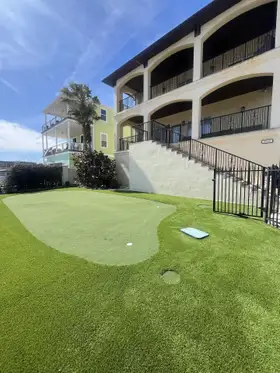
A big Nassauville lot has room for a green with several pins and a proper fringe, on a base meant to stay firm through summer storms. Most parcels need no board's sign-off.
See the rule on putting greens
The island's golf is 15 minutes away. The room to practise is here.
Nassauville itself has no course, but the Amelia Island golf cluster is 15 to 20 minutes away: The Golf Club at North Hampton, an Arnold Palmer design with more than 40 feet of elevation change and ten spring-fed lakes lined with coquina boulders (The Golf Club at North Hampton), Amelia National, the 27-hole municipal Fernandina Beach Golf Club, and the island's resort and club courses.
What a club can't give you is a green behind the house. On a big Nassauville lot there's space for a putting green with several pins and a proper fringe, on a base meant to stay firm through August's afternoon storms, and most parcels need no board's sign-off to build it.
-
County code
Keep turf out of the marsh buffer, twenty-five feet of undisturbed native vegetation and never less than fifteen. The county's synthetic-landscaping rule doesn't ban a back-yard lawn.
See the rule on county code
Nassau County's code, a 25-foot marsh buffer, and no HOA.
Nassauville is unincorporated, so the county's development rules apply, not a city's, and most parcels carry no deed restrictions or review board at all. The county's landscaping section, § 37.05, says synthetic or artificial trees, shrubs, groundcovers and vines are not acceptable substitutes, which keeps synthetic material out of the required landscaping on plans that trigger review, such as commercial, multi-family and subdivision work. It doesn't ban a back-yard lawn (Nassau County code).
The same section asks single- and two-family lots for at least one tree per 3,000 square feet across the first quarter acre, plus one per quarter acre after that, and existing canopy trees, sabal palms and pines all count. On an acre of oaks and palms, the trees you already have usually cover it, and turf can run between them.
Stop the green short of the marsh as well. Article 37 holds a minimum undisturbed natural vegetative upland buffer of twenty-five feet between developed areas and contiguous wetlands, measured from the St. Johns River Water Management District or DEP wetland jurisdictional line; averaging can pull it in where a reduction is unavoidable, but never below fifteen feet. The buffer stays as it is: the section's closing note tells the developer to inform any prospective buyer that the required buffer of native vegetation is not to be disturbed or removed at any time by the property owner, so it is not somewhere turf goes. One unpaved walkway or elevated catwalk up to five feet wide may cross it per lot. Where a project needs a permit from the water management district, the buffers that district approves apply instead (Nassau County § 37.03).
State law adds less than you'd think on a big parcel. Florida's protection against county turf bans, created by HB 683 in 2025, reaches only single-family lots of up to an acre, with DEP's standards in force since 19 May 2026 (HB 683). On a larger parcel, the county code above is what governs.
What we install in Nassauville
Choose your turf project.
Compare a green, pet area or lawn inside the usable part of your property.
-
Putting greens
Practice your putting right outside your back door.
See putting greens -
Artificial lawns
Spend less time mowing, with an artificial lawn planned around your yard and its use.
See artificial lawns -
Pet turf
A dog run or pet lawn planned around drainage, secure edges and regular cleaning.
See pet turf
FAQ
Turf questions in Nassauville.
Who installs artificial turf in Nassauville, FL?
We install putting greens, pet turf and whole-yard lawns in Nassauville, FL, along Nassauville Road on the Nassau River. Most parcels carry no HOA, and many have room for a full practice green. The ground steps from sandy ridge to marsh over a hardpan that perches the water, so we build the base for perched water and keep it clear of the septic drainfield. Call 303-349-2368 for a free estimate.
Can I put a putting green over my septic drainfield?
Plan it somewhere else on the acre. The ground that has to stay clear is bigger than the drainfield itself: unobstructed land at least 1.5 times as large as the drainfield absorption area, counting the drainfield in that total, contiguous to it and on top of the setbacks (Rule 62-6.005, F.A.C.). We locate the tank, the field and that reserve on the free visit and keep the green off all three. Synthetic turf is not named in the septic rules either way, so ask the health department in Nassau County in writing how it treats a turf base over that area.
How close to the marsh can the turf go?
Plan on the green stopping at least twenty-five feet back from the wetland line. Nassau County requires an undisturbed natural vegetative upland buffer of that width between developed areas and contiguous wetlands, measured from the SJRWMD or DEP jurisdictional line, and averaging never takes it below fifteen feet. The section's note adds that the required buffer of native vegetation is not to be disturbed or removed at any time by the property owner (Nassau County § 37.03). Where that jurisdictional line falls on your parcel is set by the district or DEP, so ask Nassau County Planning on 904-530-6320 how the buffer reads for your address before the marsh-side edge is final.
Do I need permission to put turf on my Nassauville property?
Most parcels have no HOA or review board to ask, and the county's landscaping section doesn't ban a back-yard lawn (Nassau County code). Where a plan needs required landscaping, as on commercial, multi-family or subdivision work, synthetic material can't count toward it.
Where is Nassauville?
On the north bank of the Nassau River near its northernmost bend, strung along CR 107, Nassauville Road, which runs about 5 miles south off A1A to near Holly Point. Goffinsville Nassau River Park, at the end of Old Nassauville Road, looks across the river toward Amelia Island, and Mount Olive Missionary Baptist Church is on the National Register (Nassauville, Florida).
Free estimate
Your free estimate in Nassauville.
Tell us about your project and we’ll call to arrange a free visit.
Or call 303-349-2368
Your free estimate includes
- A visit to measure your space
- A custom layout, drawn for your space
- Turf options, side by side
- A written price, with no pressure to sign
Five short steps. We’ll call to arrange your visit.