
Amelia City, FL
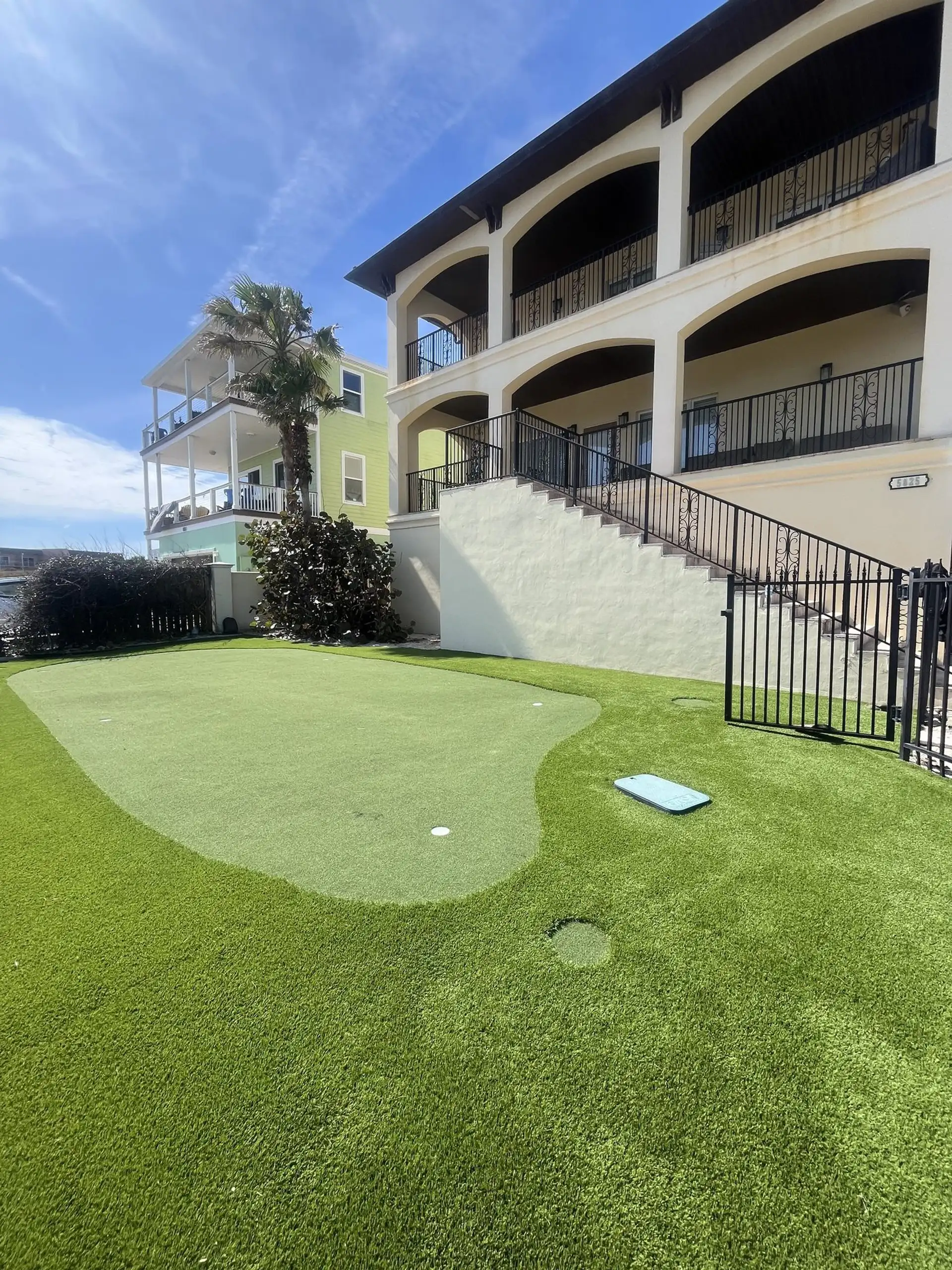
Artificial turf in Amelia City, FL, around trees that need a permit to remove.
Keep the wooded lot and add a lawn, pet area or putting green in the clearing. Nassau County's rules apply here, not Fernandina Beach's. Free visit and written estimate.
- Keep trees and existing paths in view
- Choose a useful lawn or practice area
- Include waterfront conditions in the scope
- Layout approved before installation
- American-made turf
- Free estimates, no pressure
The short answer
What should an Amelia City turf project consider first?
The trees. Any healthy tree 5 inches across or more is protected, and each kept tree gets a protection zone around its trunk. Mark them, plus wet spots and any dune or community limits, before the layout.
Before you install in Amelia City
What to know in Amelia City.
The rules in short. We measure and check the ground at a free visit, then draw a layout that fits.
-
A wooded island yard
Fit the green into a clearing that keeps the wooded lot intact, with room to walk around it. Mark tree canopy and roots first, and keep leaves in the care plan.
See the rule on a wooded island yard
Fit the green into a clearing you can reach.
A putting green can leave the rest of a wooded lot intact. Choose the putts you want, the route from the house and room to walk around the surface. A lawn or pet area closer to the door can remain separate.
Mark tree canopy and roots before discussing preparation. Keep leaves and other debris in the care plan, and establish any required tree advice before proposing work beneath the canopy.
-
Marsh or beach side
On a river-facing lot, bring shoreline and drainage details and show where water collects, since new turf alone won't fix a wet yard. Near the beach, check dune restrictions before setting the layout.
See the rule on marsh or beach side
Let the actual property set the boundary.
On an Amelia River-facing lot, bring known shoreline and drainage information and show where water collects. Near the beach, identify any coastal or dune restrictions before placing the work area. A surface replacement alone will not resolve a wet-yard problem.
Use Nassau County requirements for an unincorporated parcel, plus the current rules of any private community. Do not assume Fernandina Beach’s historic review applies to the entire island or that a south-island address has no review at all.
-
Whose rules
Fernandina Beach's historic review doesn't reach Amelia City; Nassau County's code and building department do. In a private community, the board has a say on turf color, height and edging.
See the rule on whose rules
County rules here, not the city's design review.
Amelia City is an unincorporated community on the south half of Amelia Island, so the City of Fernandina Beach's Land Development Code and its Historic District Council, with its Certificate of Appropriateness process, don't apply (Amelia City). Your turf job answers to Nassau County's development code and building department instead. That's a different path from the one a homeowner in the National Register district six miles north walks, not a lighter one: the county keeps a tree law written for this stretch of island alone.
That doesn't mean nobody reviews the yard. Plenty of south-end addresses sit inside private communities, Summer Beach, Amelia Island Plantation and Amelia Surf & Racquet Club among them, whose boards have a say on the color, height and edging of any turf, and on the beach side, state coastal-construction and dune-protection limits apply. Florida's Florida-Friendly Landscaping law won't override any of it, since it doesn't clearly protect synthetic turf (our guide to Florida-Friendly law and HOAs).
-
Tree protection zones
Removing a healthy tree 5 inches or more across usually takes a county permit, and each kept tree gets a protection zone. Ask the county arborist whether a turf base can go inside one.
See the rule on tree protection zones
The oaks set the edge of the base.
Amelia City has a tree law the mainland doesn’t. On 9 August 2021 Nassau County adopted Ordinance No. 2021-012, § 37.02 of the county code, to limit the loss of trees in the unincorporated areas of Amelia Island (Nassau County). It went into effect on 7 February 2022 (ordinance summary). Fernandina Beach runs its own rules, and Nassauville across the river sits outside it altogether.
Two numbers shape a layout here. Under § 37.02 as codified through April 2026, a protected tree is any healthy tree measuring 5 inches or more in diameter at breast height that isn’t on the Florida Exotic Pest Plant Council’s Category I or II invasive list, and removing one takes a permit from the county planning department unless the code exempts it. A live oak of 40 inches or more, or a multi-trunk live oak of 60 inches combined, is a specimen tree. None of the code’s exemptions apply to those: removal goes to the Nassau County-Amelia Island Tree Commission at a public hearing, which weighs whether the tree is dead, fallen or compromised and likely to fail, whether keeping it removes all economically viable use of the property, or whether no feasible design would save it (Nassau County Code § 37.02).
Every protected tree you keep gets a tree protection zone: a circle around the trunk whose radius is six times the trunk’s diameter, and never less than 72 inches (6 feet). The code’s own examples put a 50-inch trunk at a 300-inch (25-foot) radius and an 8-inch trunk at the 72-inch minimum, so a 20-inch trunk gets 120 inches, or 10 feet (Nassau County Code § 37.02). The county’s one-page summary gives that 20-inch tree a 15-foot zone, which doesn’t match the formula; the summary itself tells you to review § 37.02 for the full requirements (ordinance summary), so plan to the code. Encroaching into the zone takes an ISA-certified arborist’s written finding that it won’t harm the tree, verified by the county’s arborist, and the Tree Commission can allow a smaller zone where the full size would needlessly destroy trees that sound management could otherwise save (Nassau County Code § 37.02).
Inside the zone the code bars all development activity apart from a short permitted list: buildings, structures, paving surfaces and temporary construction work, including all digging, material storage and construction-vehicle parking. Any trenching or excavation in the zone of a tree being kept has to be bored or tunnelled instead of dug. The permitted list is underground utility work by utility providers, ground covers such as mulch, pine straw or pine bark with the ground prepared by hand, and hand trimming of underbrush; artificial turf isn’t on it. Separately, site development has to protect trees from grade changes, excavation, root compression and new impervious surfaces, and the code counts excavation, grading and depositing fill or aggregate as development activity (Nassau County Code § 37.02). It doesn’t name a residential turf base either way. Email the county arborist at treeinfo@nassaucountyfl.com with a tree survey before the layout is fixed, ask them to confirm each tree’s zone on the plan, and ask whether your turf base counts as development activity or a new impervious surface there, because the answer to whether turf counts as impervious varies by jurisdiction.
-
Water
The Phase III order allows one irrigation day a week, never between 8 a.m. and 6 p.m., and it covers private wells too. A turf lawn simply drops off that schedule.
See the rule on water
One day a week, whatever the water source.
Water Shortage Order 2026-017 put the district’s portion of Nassau County, the unincorporated south island included, under a Phase III Extreme Water Shortage. The district declared it on 13 May 2026 (SJRWMD) and said it was still in effect on 3 September 2026: a single irrigation day each week, Saturday for an odd or no street number and Sunday for an even one, nothing between 8 a.m. and 6 p.m., and aesthetic water use banned (SJRWMD watering restrictions).
If you're on the public system out here it's Nassau Amelia, largely south of A1A, which moved from Nassau County to the Florida Governmental Utility Authority on 18 September 2025, so the bill comes from FGUA and not the City of Fernandina Beach utility (FGUA). FGUA publishes no schedule of its own and sends customers to the water management district and the county instead (FGUA water restrictions). Some south-end parcels are on wells instead, and the restrictions cover private wells and pumps as well as utility water (SJRWMD watering restrictions), so check what your address actually runs on.
Outside a shortage, the district allows twice-weekly watering in daylight saving time and once-weekly in winter (SJRWMD). No rebate for artificial turf is on offer from the water management district. Turf simply drops off the watering schedule.
What we install in Amelia City
Choose your turf project.
Compare a lawn, pet area and putting green for the usable space among the existing landscape.
-
Artificial lawns
Spend less time mowing, with an artificial lawn planned around your yard and its use.
See artificial lawns -
Putting greens
Practice your putting right outside your back door.
See putting greens -
Pet turf
A dog run or pet lawn planned around drainage, secure edges and regular cleaning.
See pet turf
FAQ
Turf questions in Amelia City.
Who installs artificial turf in Amelia City, FL?
We install artificial lawns, pet turf and putting greens in Amelia City, FL, on the south end of Amelia Island. Amelia City is unincorporated, so Nassau County's code applies rather than Fernandina Beach's and its Historic District Council. Many lots face the Amelia River across tidal marsh, where the water table runs high, so the base and drainage decide the job. Call 303-349-2368 for a free estimate.
Is Amelia City part of Fernandina Beach?
No. Amelia City is an unincorporated community on the south half of Amelia Island, along A1A near the Amelia River, so Nassau County, not the city, sets the rules (Amelia City). Fernandina Beach is the island's only incorporated city.
Will turf drain on a lot that backs onto the marsh?
Yes, with a base designed for a high water table. West-side lots near the Amelia River sit on the poorly drained soils Nassau County's comprehensive plan flags, so base depth and drainage matter more than the turf you choose (Nassau County). We check the lot on the free visit.
Do trees on my lot need a permit before turf goes in?
Only if a protected tree has to come out. On unincorporated Amelia Island, § 37.02 of the county code protects any healthy tree of 5 inches or more in diameter at breast height that isn’t on the Florida Exotic Pest Plant Council’s Category I or II invasive list, and removing one takes a permit from the county planning department. Smaller trees aren’t protected. The code exempts fallen trees, minor maintenance done to the International Society of Arboriculture’s practices, storm-damaged or hazardous trees during and for a month after a declared weather emergency, and a tree on residential property that an ISA-certified arborist, or a landscape architect holding a Florida licence, documents as a danger to people or property (Nassau County Code § 37.02). Trees you keep matter too: each gets a protection zone with a radius of six times its trunk diameter, never less than 72 inches, where development activity and digging are barred unless an ISA-certified arborist finds in writing that the work won’t harm the tree and the county’s arborist agrees. Email treeinfo@nassaucountyfl.com with a tree survey before the plan is fixed, and ask how the county treats a turf base inside that zone.
Who supplies the water here?
On the public system it's Nassau Amelia, largely south of A1A, run by the Florida Governmental Utility Authority since 18 September 2025 rather than by the county (FGUA). FGUA sets no irrigation days itself and sends customers to the water management district and the county (FGUA water restrictions). Some parcels out here are on wells instead, so read your own bill before you assume either way.
Nearby areas we cover
Free estimate
Your free estimate in Amelia City.
Tell us about your project and we’ll call to arrange a free visit.
Or call 303-349-2368
Your free estimate includes
- A visit to measure your space
- A custom layout, drawn for your space
- Turf options, side by side
- A written price, with no pressure to sign
Five short steps. We’ll call to arrange your visit.