
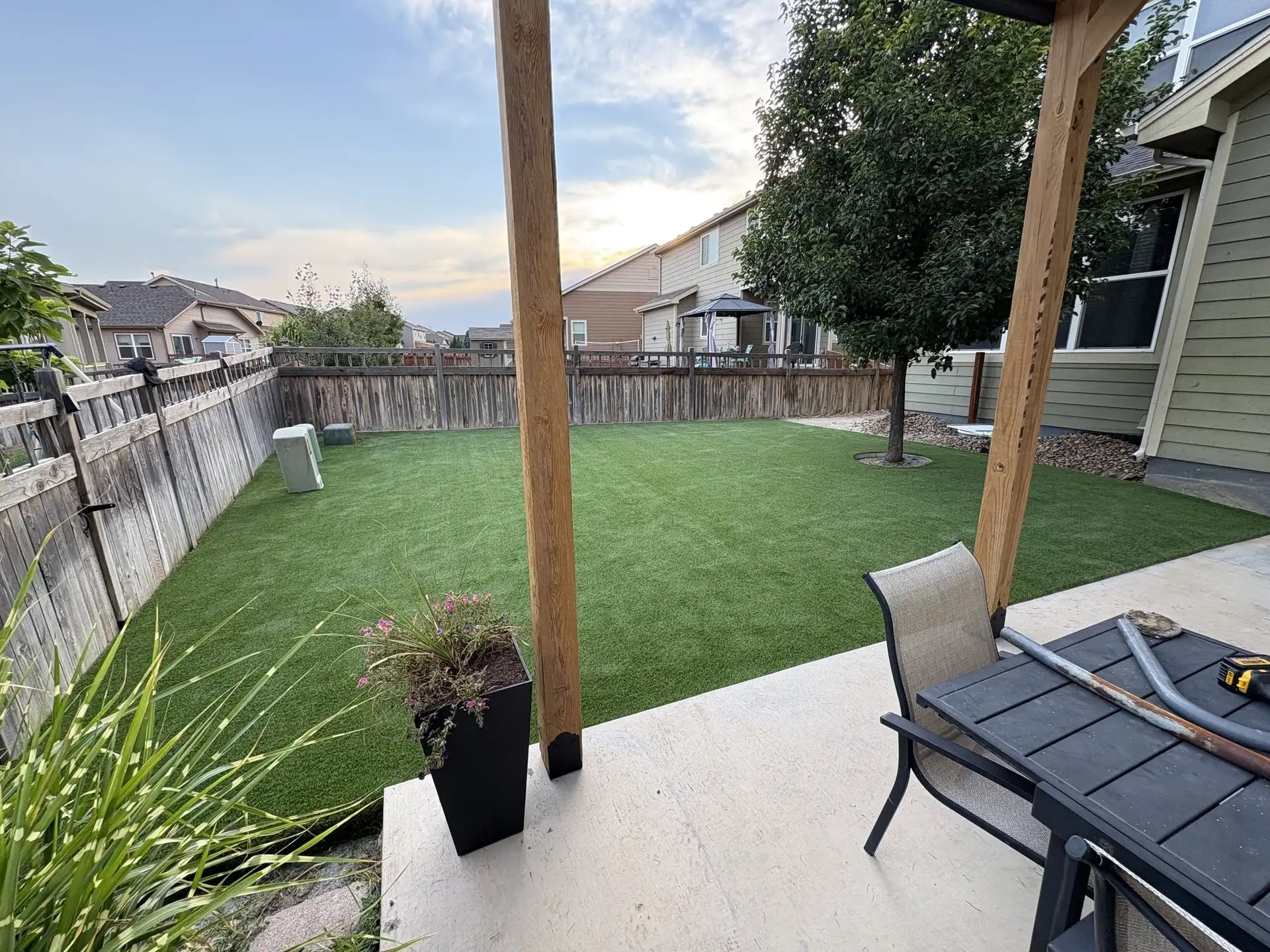
Surfside Beach, SC
Artificial turf in Surfside Beach, SC, planned around your lot's impervious cap.
A house, drive and patio can use most of your hard-cover allowance. At a free visit we measure what's there and draw a layout you can take to the town.
- Your existing hard cover measured against the town cap
- A layout drawn around the trees the town counts
- Turf kept landward of the shore protection line
- Layout approved before installation
- American-made turf
- Free estimates, no pressure
The short answer
Does artificial turf count toward the impervious limit in Surfside Beach?
The town code does not say. It caps impervious coverage at 40 percent in R-1, 45 in R-2 and 50 in R-3. Ask Planning, Building & Zoning how your turf and its base will count.
Before you install in Surfside Beach
What to know in Surfside Beach.
The rules in short. We measure and check the ground at a free visit, then draw a layout that fits.
-
The coverage cap
Your district sets the hard-cover limit: 40% in R-1, 45% in R-2, 50% in R-3, and turf isn't named either way. On a 6,000-square-foot R-2 lot, that's 2,700 square feet total, house and drive included.
See the rule on the coverage cap
Your district sets how much of the lot can be hard cover.
Surfside Beach writes its limits into the zoning code. In R-1, buildings may cover 30 percent of a lot and all impervious cover 40 percent. R-2 allows 30 and 45 percent, and R-3 allows 40 and 50 percent (Town Code, Sec. 17-312, 17-322 and 17-333). The town's District Regulations sheet, updated 8 February 2022, lists the same caps beside each district's minimum lot: 9,000 square feet in R-1, 6,000 in R-2 and 3,600 for a detached home in R-3.
Impervious coverage is all the flat ground on the lot with an impervious surface. The code defines that as land compacted or covered so it is highly resistant to water soaking in, and names roofs, driveways, sidewalks and parking lots (Sec. 17-007). On a 6,000-square-foot R-2 lot, the cap is 2,700 square feet in all. A house, a drive and a patio can use most of that before any turf goes down.
Artificial turf is not named there, or in the district and landscaping sections. How the town reads a packed base under draining turf decides how much room your yard has. Our guide to whether turf counts as impervious lists the product and base details to bring.
-
The approval steps
Add up your roof, drive, walks and patio and take that from your district's cap: that's your room if turf counts. Ask Planning, Building & Zoning for its answer in writing.
See the rule on the approval steps
Add up what you have, then ask one question.
Find your district on the zoning map linked from the Planning, Building & Zoning page. Add up the roof footprint, driveway, walks, patio and any pad. Take that from your district's cap. What is left is the most new hard cover the lot can take if the town counts turf against it.
Then ask the department how the proposed turf and base will count. Its line is 843-913-6341. The regulations sheet also prints 843-913-6111, which is the Town Hall number. Bring the layout, the turf's drainage data and the base detail, ask for the answer in writing, and keep it with your estimate.
At the free visit, we measure the hard surfaces already there and the area you want to change. The layout you approve shows both, so the office can check the sum.
-
The trees
Every lot has a tree minimum, already-standing trees included, and taking out one over 8 inches across needs a no-fee permit first — smaller trees need none.
See the rule on the trees
Your lot has a tree minimum, and a big tree needs a permit.
Every residential lot has a minimum: five trees totalling 60 inches across in R-1, five totalling 40 inches in R-2, and three totalling 30 inches in R-3, all measured 2 feet above the ground. The trees already standing count toward it (Article VII, Sec. 17-723).
Taking out a tree over 8 inches across needs a no-fee zoning permit first. Smaller trees need none (Sec. 17-723.2). The town's tree removal application asks you to flag or mark each tree before the inspection, allows the work from 7 a.m. to 8 p.m., Monday to Saturday, and bars leaving debris on site overnight.
If a tree stands where you want a green or a dog run, drawing around it is often simpler. Our layout marks each tree. Where one has to come out, get the permit before we start.
-
Proposed, not yet law
A draft ordinance, not yet law, would require a permit to remove trees 3 inches or more across and count pervious turf as landscaping. Today's code sets landscaped shares by district without mentioning turf.
See the rule on proposed, not yet law
A new tree and landscaping ordinance is part way through council.
Ordinance 26-1007 would replace Article VII. Council accepted first reading with changes on 10 August 2026, by a 6-1 vote, and agreed to review the fines and enforcement before second reading (council minutes). It was not on the 24 August or 8 September agendas. As of 12 September 2026, it is not law, and the final text may change.
The draft posted for first reading goes further than today's code. A permit would be needed to remove any tree 3 inches or more across, measured 4.5 feet up. Where an activity over 800 square feet needs a zoning permit, 20 to 50 percent of the lot would have to be landscaped, rising with lot size, with at least 20 percent of that in the front yard. The draft counts pervious artificial turf as landscape material.
Today's code already sets landscaped shares by district: 50 percent in R-1, 40 in R-2 and 20 in R-3. It defines landscaping as grass, ground covers, shrubs, flower beds, vines, hedges and trees, and does not mention turf (Sec. 17-701 and 17-702). If turf would cover most of your front yard, ask whether that share applies and whether turf counts.
-
Oceanfront lots
On an oceanfront lot, the shore protection line sits 20 feet landward of the rear property line or the primary dune's crest, whichever is farther from the ocean. Keep turf landward of it.
See the rule on oceanfront lots
Keep turf landward of the shore protection line.
On a lot that touches the Atlantic, the town sets a shore protection line. It runs 20 feet landward of the rear property line or 20 feet landward of the crest of the primary dune, whichever is farther from the ocean (Article VIII, Sec. 17-802).
Seaward of that line, you need a permit from the code enforcement official before you move sand or alter vegetation (Sec. 17-807 and 17-808). The town may let owners plant nonnative vegetation between the landward trough of the dune and the line, but not nonnative grass turf or covering (Sec. 17-803). So on an oceanfront lot, our layout stops at the line and the dune stays as it is.
What we install in Surfside Beach
Choose your turf project.
Choose a lawn, dog run or putting green sized to the hard-cover room your lot has left.
-
Artificial lawns
Spend less time mowing, with an artificial lawn planned around your yard and its use.
See artificial lawns -
Pet turf
A dog run or pet lawn planned around drainage, secure edges and regular cleaning.
See pet turf -
Putting greens
Practice your putting right outside your back door.
See putting greens
FAQ
Turf questions in Surfside Beach.
Who installs artificial turf in Surfside Beach, SC?
We install artificial turf, pet turf and backyard putting greens in Surfside Beach, SC. The town caps impervious cover at 40 to 50 percent of a lot and does not say where turf falls, so we measure your existing hard surfaces and draw a layout you can take to Planning, Building & Zoning. Call 720-630-0108 for a free visit.
Do I need a permit to put in turf?
Ask Planning, Building & Zoning. You need a zoning permit before removing a tree over 8 inches across, and a permit for work seaward of the shore protection line. If Ordinance 26-1007 passes as drafted, a permitted job over 800 square feet would also bring landscaping minimums.
Can I take out a pine to make room for a lawn?
Usually, with a no-fee permit. For a common tree over 8 inches across, the town issues one when a listed condition is met. Any pine other than a longleaf qualifies, and so does a tree within 10 feet of the house, foundation or driveway (Sec. 17-723.3). If removal takes the lot below its tree minimum, you replace it with another common tree.
What about a big live oak in the yard?
A live oak, laurel oak or bald cypress over 24 inches across is a landmark tree. Taking one out for a pool, an accessory structure or any use other than the house needs approval from the Board of Zoning Appeals (Sec. 17-723.5). Plan the turf around it.
Nearby areas we cover
Free estimate
Your free estimate in Surfside Beach.
Tell us about your project and we’ll call to arrange a free visit.
Or call 720-630-0108
Your free estimate includes
- A visit to measure your space
- A custom layout, drawn for your space
- Turf options, side by side
- A written price, with no pressure to sign
Five short steps. We’ll call to arrange your visit.