
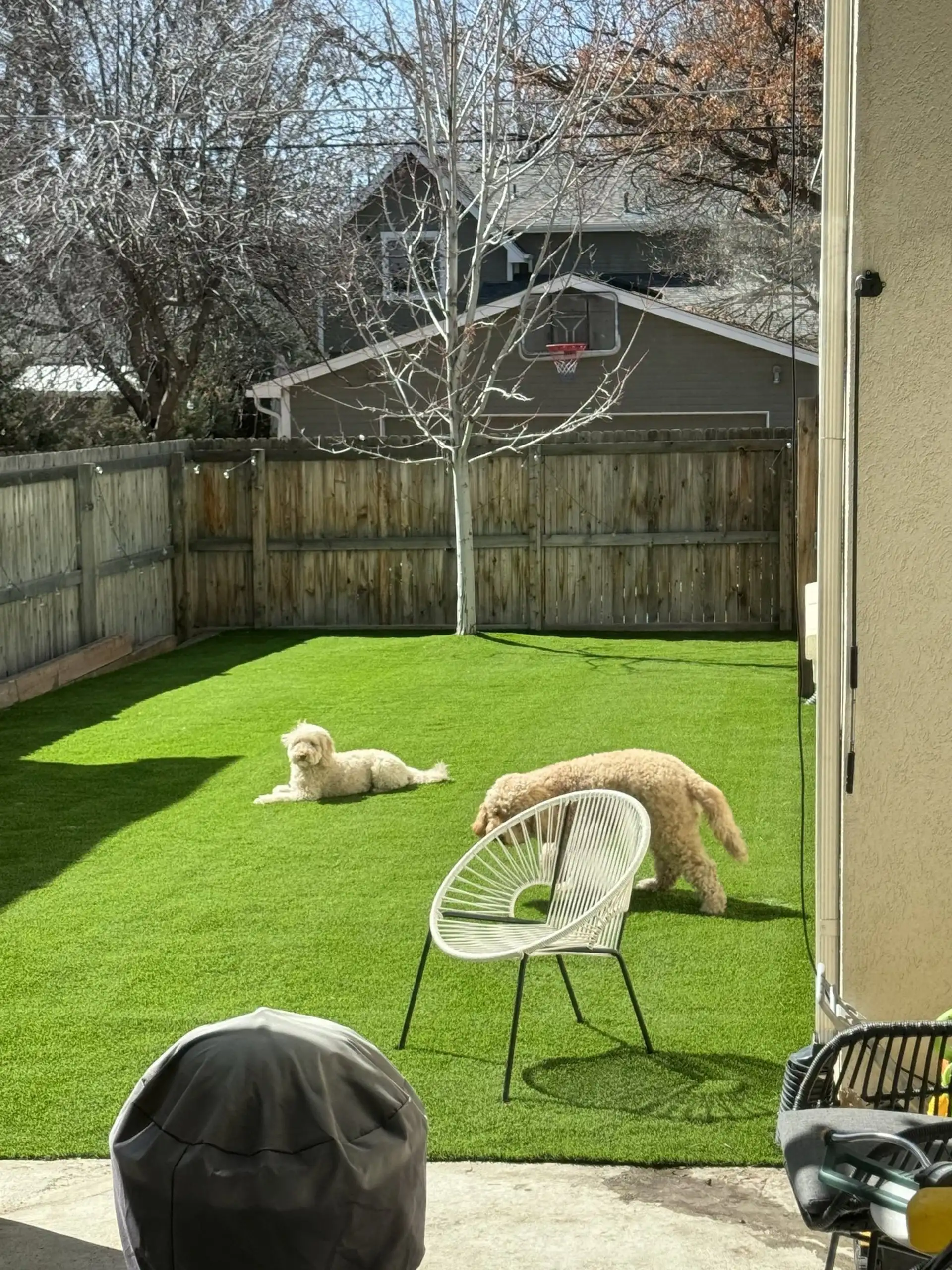
Murrells Inlet, SC
Artificial turf in Murrells Inlet, SC, planned around the marsh and protected trees.
On a marsh lot, the state's critical-area line can cross your yard. At a free visit we note the marsh edge and tree zones, and you approve the layout.
- The marsh line checked before the base is dug
- A layout drawn around the trees you keep
- Base and drainage details in writing
- Layout approved before installation
- American-made turf
- Free estimates, no pressure
The short answer
Can I put artificial turf right up to the marsh behind my Murrells Inlet lot?
Only up to the state's line, and only after you know where it falls. South Carolina counts marshes and mudflats connected to coastal waters as critical area, and no one may fill, drain or alter it without a state permit.
Before you install in Murrells Inlet
What to know in Murrells Inlet.
The rules in short. We measure and check the ground at a free visit, then draw a layout that fits.
-
The marsh line
Base stone or grading that reaches the marsh needs a state permit. At the free visit we note the marsh edge and draw the layout to stop clear of it.
See the rule on the marsh line
Murrells Inlet backs onto tidal creek and salt marsh the state regulates.
Murrells Inlet grew up as a fishing village on the creek, in northeastern Georgetown County, and the Marshwalk boardwalk overlooking the salt marsh is still the place's landmark today. A lot that backs onto the creek or the marsh behind it sits against water South Carolina treats differently from an ordinary backyard.
State law defines tidelands as areas at or below mean high tide and the coastal wetlands connected to them, marshes and mudflats included, and counts tidelands among the state's critical areas alongside coastal waters and beaches (SC Code §48-39-10). No one may fill, remove, dredge, drain or in any way alter a critical area without a permit from the state's Bureau of Coastal Management, the successor office to OCRM inside the Department of Environmental Services since July 2024.
That reaches ordinary yard work: grading the ground for a turf base, or running fill or base stone toward the marsh edge, is the kind of alteration the permit rule was written for. Anyone may also ask the department to review a project and say within forty-five days whether it is exempt.
At the free visit, we measure the yard, note where the ground turns to marsh, and draw the layout to stop clear of that edge. If the line is close, we tell you to get it confirmed with the state before the base goes in.
-
The tree rule
Most trees at least 10 inches across are protected, and digging in a tree's no-dig zone needs a county permit. We pace each zone at the visit and draw the turf outside it.
See the rule on the tree rule
Inland, a 10-inch tree is protected under the county's Waccamaw Neck overlay.
Georgetown County's tree overlay covers the whole Waccamaw Neck, the land between the Horry County line, the Waccamaw River and the ocean, and Murrells Inlet sits inside it (Georgetown County Zoning Ordinance, Article XIII, as amended by Ord. 23-24). A tree at least 10 inches across, measured 4.5 feet up the trunk, is protected unless it's a palmetto, Bradford pear, pecan, sweet gum, crepe myrtle, wax myrtle or a pine other than longleaf. A longleaf pine is protected only once it reaches 15 inches, and only on land that isn't a single-family lot.
An occupied single-family lot doesn't have to replace a tree it removes, but it still needs the county's permit before removing or damaging a protected one. The ordinance counts digging and grading as damage, not just cutting the trunk down, so a turf base dug under the canopy is the kind of work the permit rule was written to catch.
Each protected tree's no-dig zone runs out from the trunk one foot for every inch of diameter, or to the canopy's edge if that reaches farther. A 12-inch live oak carries at least a 12-foot zone. At the visit, we pace out each tree's zone on your lot and draw the turf edge to sit outside it, or flag the ones close enough that the county should see the plan first.
-
Getting the plan reviewed
Removing or damaging a protected tree without a permit risks a fine up to $12,000 and can hold back other permits for up to three years. Most yards never need that permit at all.
See the rule on getting the plan reviewed
A close call goes to the county's Zoning Administrator before the dig.
Tree removal permits come from the Zoning Administrator's office. For a yard that's easy to see from the street, county staff may visit and mark the trees in person instead of reviewing a drawn plan. Either way, no removal permit is issued until that review is finished, and a conditional approval or a refusal comes back with the reasons in writing.
Skipping the permit is expensive: a person who removes or damages a protected tree without one faces a fine of up to $12,000 for that tree, and the county can hold back other permits on the property for up to three years. An appeal of the county's decision goes to the Zoning Board of Appeals within thirty days.
None of this applies to a healthy yard clear of both lines. Most turf jobs here never touch a permit desk; the point of the free visit is finding out early which lots do.
-
Inside the gated neighborhoods
Prince Creek and International Club are each made up of many separately named neighborhoods, not one shared HOA. Get your own neighborhood's current landscaping guidelines before you plan a layout there.
See the rule on inside the gated neighborhoods
Prince Creek and International Club are golf communities built from many separately named neighborhoods.
Prince Creek, the golf community around TPC Myrtle Beach, isn't one HOA with one landscaping rulebook. Real-estate coverage of the community describes it as several distinct neighborhoods, some gated and built out on their own (privatecommunities.com), and the Greater Burgess Community Association's own neighborhood directory lists each one as its own member community rather than as a unit of a single shared association (Greater Burgess Community Association). Bellwood Landing, Collins Creek Landing, Creek Harbor, Creekhaven, Highwood, Hunters Grove, Laurel Bay, Linksbrook, Marcliff West, Seasons, Shallow Creek Bay, Stonegate, The Bays, Waverly Bay and Willow Bay are all part of Prince Creek this way. Highwood keeps its own governing documents and rules section on its HOA site; ask Highwood's HOA for its current landscaping rules before you plan a layout there. For a lot in any of these neighborhoods, get your own HOA's current design-review or landscaping guidelines before you plan a turf layout, and check them against the marsh and tree rules above if the lot borders tidal water.
International Club, off International Club Boulevard, works the same way. Cambridge, Enclave, Grand Vistas, The Glens and The Villas are each listed as their own neighborhood in the same civic directory. Ask your neighborhood's HOA for its current landscaping guidelines before you plan turf on one of these lots, and the marsh and tree rules above still apply if the lot borders tidal water.
-
The stormwater fee
A single-family home pays a flat $52 a year in stormwater fees, so a turf lawn won't change the bill. On other property, ask county staff how draining turf is counted.
See the rule on the stormwater fee
A single-family home in Georgetown County pays a flat yearly fee, turf or not.
Georgetown County charges every property with 400 square feet or more of impervious area a stormwater fee on the tax bill. A single-family home pays for one Equivalent Runoff Unit, set at $52 a year, no matter its exact roof and driveway area; other property is billed on its measured impervious area, rounded up to the next unit.
County guidance lists grass as pervious and doesn't name artificial turf either way (Georgetown County stormwater fee FAQ, checked September 2026). A new residential lawn won't move a homeowner's flat fee, so this isn't a reason to install or skip turf at a house. On other property types where the fee is measured, ask county stormwater staff how they'd count a draining turf system before you budget for it; our guide to whether turf counts as impervious has the questions to bring.
What we install in Murrells Inlet
Choose your turf project.
A lawn, dog area or putting green laid out around the marsh line and the trees you keep.
-
Artificial lawns
Spend less time mowing, with an artificial lawn planned around your yard and its use.
See artificial lawns -
Pet turf
A dog run or pet lawn planned around drainage, secure edges and regular cleaning.
See pet turf -
Putting greens
Practice your putting right outside your back door.
See putting greens
FAQ
Turf questions in Murrells Inlet.
Who installs artificial turf in Murrells Inlet, SC?
We install artificial turf, pet turf and backyard putting greens in Murrells Inlet, SC. At a free visit we measure the yard, check the ground, and note the marsh edge and any protected trees before we draw the layout. Call 720-630-0108.
My yard runs down to the marsh. What should I ask the state before turf goes in?
Ask the Bureau of Coastal Management to confirm the critical-area line for your lot and whether your planned layout, grading and base fall outside it. Anyone can request that review, and the state has forty-five days to answer.
Does a storm-damaged tree still need a county permit to come out?
Not right after a natural disaster that County Council declares a catastrophic loss: a tree felled or damaged beyond reasonable recovery may then come out without a permit. Otherwise, a diseased, injured or dangerous tree needs the county's authorization first, and the county may ask for a written report from a tree professional.
My address is on the Horry County side of the line. Do these rules apply?
Murrells Inlet itself sits in Georgetown County. If your parcel is actually in Horry County, these county rules don't reach it; see our Garden City page, which covers the same county line.
Nearby areas we cover
Free estimate
Your free estimate in Murrells Inlet.
Tell us about your project and we’ll call to arrange a free visit.
Or call 720-630-0108
Your free estimate includes
- A visit to measure your space
- A custom layout, drawn for your space
- Turf options, side by side
- A written price, with no pressure to sign
Five short steps. We’ll call to arrange your visit.