
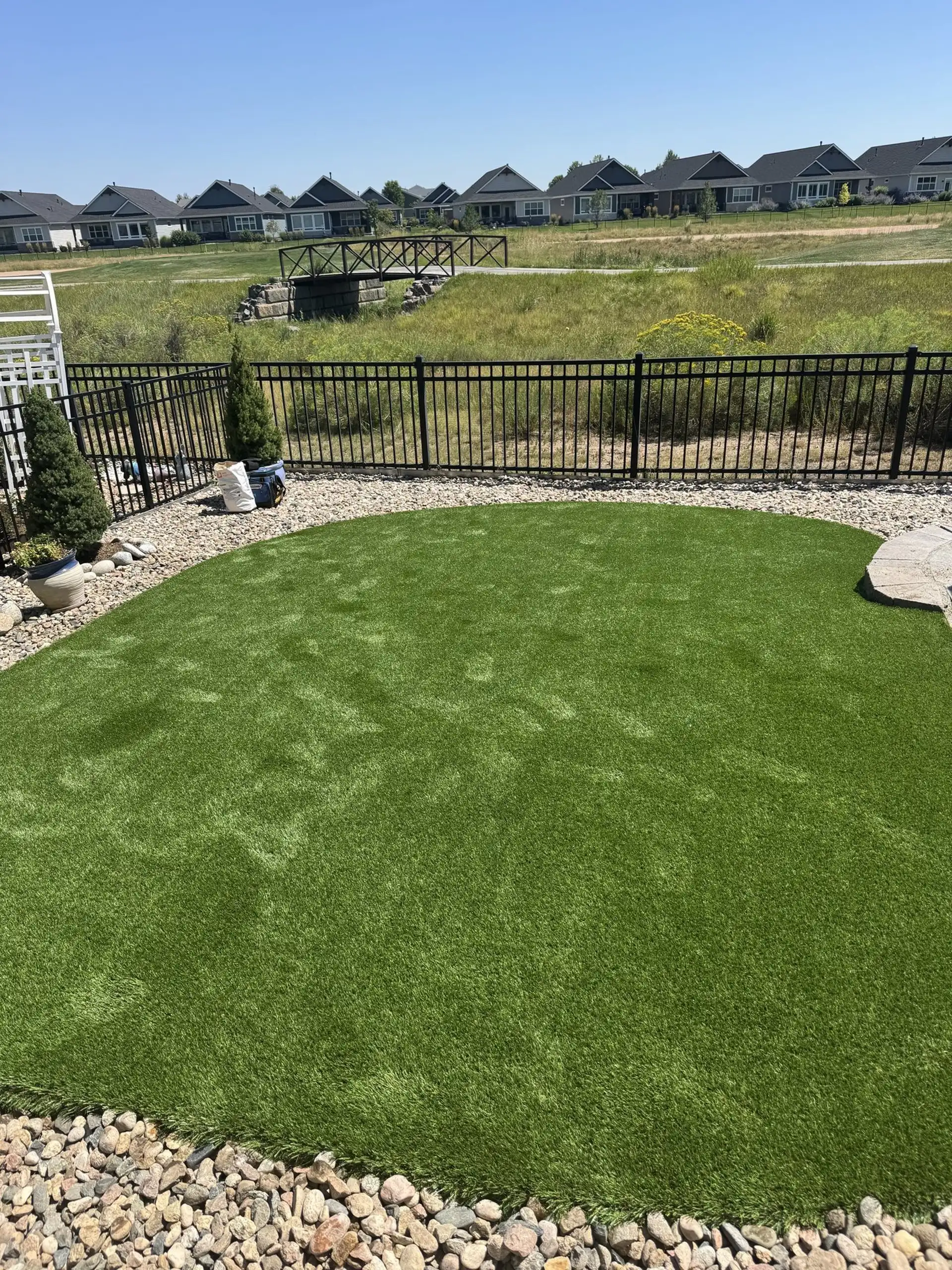
Grissettown, NC
Artificial turf in Grissettown, NC, planned around Brunswick County's own rules.
Grissettown has no town hall, so Brunswick County's rules, including its 4-inch grading trigger, apply to your yard. We measure at a free visit and draw a layout you approve.
- Know whether your base counts as the County's 4-inch trigger
- Keep the turf edge outside the 30-foot stream buffer
- A layout you approve before any ground gets moved
- Layout approved before installation
- American-made turf
- Free estimates, no pressure
The short answer
Do I need a County stormwater permit for artificial turf in Grissettown, NC?
Only if the work hits a County trigger. The two a turf job most likely hits: filling or digging that changes your lot's surface by 4 inches or more and alters drainage, or disturbing land within 30 feet of a stream bank.
Before you install in Grissettown
What to know in Grissettown.
The rules in short. We measure and check the ground at a free visit, then draw a layout that fits.
-
The County's numbers
Brunswick County's ordinance, not a town hall, sets the rules. A base that changes your lot's surface by 4 inches or more and shifts drainage can trigger a stormwater permit — ask the County first.
See the rule on the county's numbers
In Grissettown, it's the County's 4-inch rule that decides how much paperwork your turf needs.
Grissettown sits in unincorporated Brunswick County, between Shallotte and Sunset Beach, and carries no municipal government of its own. That means the County's Stormwater Ordinance applies here directly, the way a town code applies inside a town's limits. The County's Stormwater Quality Management and Discharge Control Ordinance was in full force and effect as of September 15, 2002, and Section 1.4 applies it to all areas within the County's planning jurisdictional limits.
Section 1.16(b) sets out when a Stormwater Management Plan, and the Stormwater Permit that comes with it, is required. Two of its four triggers are the ones a turf job is most likely to hit: any filling or excavation of a parcel that changes the land surface by 4 inches or more and alters the existing drainage pattern, and any activity that disturbs land within 30 feet of the banks of a stream or other natural waterway, unless the County's Storm Water Management Manual marks that disturbance as exempt or allowable. A base for artificial turf is commonly cut and built up close to that 4-inch mark, so it's worth measuring before you assume you're under it.
Two more triggers apply to bigger jobs: all non-residential development and any major subdivision, and any activity that disturbs a total area of one acre or more (with exemptions for a bona fide farm, forestland timber work, and permitted mining). Where none of Section 1.16(b)'s triggers apply, Section 1.16(a) says a Stormwater Permit isn't required at all. Ask the County's Stormwater Administrator which side of that line your yard falls on before the layout is final.
-
The 30-foot buffer
A stream or natural waterway on your lot carries an undisturbed 30-foot buffer from the top of the bank. We keep the base and turf outside that line unless the County says otherwise.
See the rule on the 30-foot buffer
A stream on your lot carries its own 30-foot setback.
Section 1.17 of the Ordinance requires a riparian buffer on all sides of perennial and intermittent streams, lakes and other natural waterways in the County, maintained as provided in the Storm Water Management Manual. The buffer itself is defined precisely: an undisturbed area extending from the top of the channel bank landward a minimum of 30 feet, measured horizontally on a line perpendicular to the water body. New structures aren't allowed inside it, apart from the specific exceptions the Ordinance lists, such as water-dependent structures and roads or utilities with no practical alternative route.
The Ordinance does carve out some ground from that buffer rule: reaches shown on a USGS or NRCS map where the stream doesn't actually exist on the ground, farm ponds not part of a natural drainage way, ditches, and manmade conveyances other than a modified natural stream. Whether a feature on your lot counts as a natural drainage way or an exempt ditch isn't always obvious from the yard, so that's a question for the County rather than a guess before we set the turf edge.
If your lot backs onto a branch of the Shallotte River watershed or any other mapped waterway, we keep the base and the turf itself outside that 30-foot line unless the County tells us otherwise in writing.
-
What counts as impervious
The County's built-upon area rule leaves out number 57 stone at least four inches thick over fabric, but doesn't name artificial turf. Ask the Stormwater Administrator how your turf base counts.
See the rule on what counts as impervious
The Ordinance names gravel and stone. It doesn't name artificial turf.
The Ordinance's definition of Built-upon Area (BUA) covers impervious surface, and partially impervious surface, to the extent it keeps water from soaking through into the subsoil. It specifically excludes a few things: a slatted wood deck, the water area of a swimming pool, and a surface of number 57 stone, as designated by the American Society for Testing and Materials, laid at least four inches thick over a geotextile fabric.
That last exclusion is written for stone, not turf, and artificial turf is not named in the BUA definition either way. The Ordinance's definition also excludes a trail, as defined under state law, that is unpaved, or paved with a surface porous enough to reach a hydraulic conductivity greater than 0.001 centimeters per second, which the Ordinance itself converts to 1.41 inches per hour. That figure is written for trails specifically; nothing in the Ordinance's text extends it to a residential turf install, so don't take it as a stand-in number for how the County will treat your base.
Ask the County's Stormwater Administrator directly how a turf base is counted before you're close to the 4-inch trigger or the acreage threshold. Our guide to built-upon area on both sides of the state line covers the state statute on draining turf backing, which is a separate question from how this County ordinance defines BUA.
-
Which office, and the town line next door
Grissettown is a community name, not a zoning line, and some parcels could fall inside an incorporated town with its own rules. Confirm your parcel with the County before you plan.
See the rule on which office, and the town line next door
Confirm you're actually in the unincorporated County before you plan around it.
Grissettown's name isn't a zoning boundary. It marks a community along Longwood Road, between Shallotte and Sunset Beach, and parts of that area could fall inside an incorporated town's limits depending on the parcel. Sunset Beach and Calabash each run their own separate town ordinances, not the County's, so it matters which side of the line your address sits on. Confirm your parcel's status with the County's Planning & Community Development office, or its GIS mapping, before assuming this County ordinance is the one that governs your yard.
The community's one long-standing local institution is Grissettown Longwood Fire & Rescue, a volunteer department that has served this part of Brunswick County since 1985. It doesn't issue stormwater or building permits, but it's a fixture of the area worth knowing if you're new to it.
Whichever office it turns out to be, take your address and a rough layout to them before ground gets moved. Confirming jurisdiction first saves you from planning around the wrong rulebook.
-
The free visit
At the free visit we measure and check the ground. Your layout states the base depth in inches, so you can hold it against the County's 4-inch trigger and 30-foot buffer.
See the rule on the free visit
We measure and check the ground before anything is dug.
At the free visit, we measure the area you want to turf and check the ground: where water sits after rain, how close any stream or ditch runs to the layout, and how deep the base has to go. The custom layout you approve before work starts states the depth of that base in inches, so you can hold it against the County's 4-inch trigger and the 30-foot buffer before anything changes.
With the County's answer in hand, we prepare the site, build a base sized to your soil and the buffer line, lay, seam and edge the turf, add infill, clean up, and walk you through the care it needs. If a putting green or a dog run is part of the plan, see our Grand Strand putting greens page and Grand Strand pet turf page for how each is laid out.
What we install in Grissettown
Choose your turf project.
A lawn, a dog area or a backyard green, each based and edged around the County's 4-inch trigger and any stream buffer on your lot.
-
Artificial lawns
Spend less time mowing, with an artificial lawn planned around your yard and its use.
See artificial lawns -
Pet turf
A dog run or pet lawn planned around drainage, secure edges and regular cleaning.
See pet turf -
Putting greens
Practice your putting right outside your back door.
See putting greens
FAQ
Turf questions in Grissettown.
Is Grissettown inside a town, or unincorporated Brunswick County?
Grissettown is a community name, not a town government, and it sits in unincorporated Brunswick County along NC 904 between Shallotte and Sunset Beach. Some nearby parcels can fall inside an incorporated town's limits. Confirm your parcel's status with the County's Planning & Community Development office or its GIS map before assuming County rules, rather than a neighboring town's ordinance, apply to your address.
Does a turf base always trigger a County stormwater permit here?
Not always. The Ordinance requires a Stormwater Management Plan, and the permit with it, only when a listed trigger applies, such as a 4-inch or greater change in land surface that alters drainage, or disturbance within 30 feet of a stream bank. If none of the Ordinance's triggers apply to your job, Section 1.16(a) says a permit isn't required. Ask the County's Stormwater Administrator to confirm which applies to your layout.
What should I ask Brunswick County before turf goes in at my Grissettown address?
Give the County your address and the depth of base the layout calls for, then ask three things: whether your parcel is unincorporated County or inside a town, whether the job crosses the 4-inch drainage-change trigger, and whether any part of the layout falls within 30 feet of a stream bank on the property.
Free estimate
Your free estimate in Grissettown.
Tell us about your project and we’ll call to arrange a free visit.
Or call 720-630-0108
Your free estimate includes
- A visit to measure your space
- A custom layout, drawn for your space
- Turf options, side by side
- A written price, with no pressure to sign
Five short steps. We’ll call to arrange your visit.