The Grand Strand
Artificial Turf and Built-Upon Area: North Carolina Says Zero, South Carolina Says Nothing
The short version
Does artificial turf count as impervious surface in North Carolina or South Carolina?
In North Carolina, G.S. 143-214.7D says artificial turf manufactured to drain through its backing and installed to the manufacturer's specification over a pervious surface is not built-upon area, and a local government may not adopt a stricter definition. We found no equivalent South Carolina statute, so on the South Carolina side it comes down to how a permit desk applies a general impervious-surface definition that never names turf. We serve both sides of that line. One number for all three of our markets: 303-349-2368.
Built-upon area, when it is your back yard
Built-upon area is the share of your lot that rain cannot soak into: roof, driveway, patio, pool deck, gravel pad. Local governments cap it, because whatever runs off your lot has to go somewhere, and here that somewhere is a creek, a marsh or the Waccamaw.
The caps are tighter than most homeowners expect. Sunset Beach limits residential development to 45 percent impervious surface of total lot area, and 20 percent in its CR-1, CR-2 and AF-1 districts. Brunswick County's Water Quality Protection Overlay limits built-upon impervious area to 25 percent of the lot. Under the state coastal stormwater rule, a Brunswick County project stays in the low-density category only below 24 percent built-upon area, or 12 percent near SA waters and freshwater Outstanding Resource Waters; above that it is high density and has to treat the 1.5-inch storm.
So your lot has a budget and every hard surface spends some of it. The only question that matters for artificial turf is whether turf spends the budget. Crossing the state line changes the answer.
What North Carolina did in 2024
North Carolina answered it in statute. G.S. 143-214.7D(b)(6) says that for purposes of implementing State or local government stormwater programs, this is not built-upon area or an impervious surface: "Artificial turf, manufactured to allow water to drain through the backing of the turf, and installed according to the manufacturer's specifications over a pervious surface." The change came in Senate Bill 166; the engineering firm WithersRavenel dates it effective September 2024 and retroactive to July 2023.
Both conditions are load-bearing. The turf must drain through its backing, and it must go in to the manufacturer's specification over a pervious surface. The same statute separately excludes number 57 stone at least four inches thick over geotextile fabric — the base underneath — so the whole assembly can be documented as exempt.
Then the part that ends arguments at the counter. Subsection (d) bars a local government from enacting, implementing or enforcing an ordinance, comprehensive plan or stormwater program whose definition of built-upon area or impervious surface does not comply with subsection (b). A town cannot write a stricter definition than the State's.
South Carolina has no equivalent, and Horry's definition leans the other way
We found no equivalent South Carolina statute. We also found artificial turf named in none of the South Carolina codes we read — not to permit it, not to restrict it. What we read: the Horry County stormwater ordinance at Chapter 17.7, the county's 134-page Stormwater Management Design Manual, the Myrtle Beach zoning definitions, and the North Myrtle Beach code.
Silence is not permission. It moves the decision to whoever reads your plan that morning, applying a general impervious definition to a product it was not written for — and Horry's general definition leans against you. Sec. 17.7-16 lists as impervious "compacted gravel and soil surfaces, awnings and other fabric or plastic coverings." Turf is not named. A compacted aggregate base and a plastic covering are, and that is what a turf system is made of. Myrtle Beach's zoning definitions likewise count stone, shell or gravel surfacing as impervious lot coverage.
North Myrtle Beach is the one South Carolina jurisdiction here with a written way through, and it gets there without naming turf either. Sec. 23-129.4, added by Ord. No. 25-45 on 6 October 2025, lets a surface count as pervious on single-family and duplex work not subject to site-specific development plan review if it demonstrates a minimum infiltration rate of two inches per hour based on manufacturer testing or accepted industry standards, is installed to the manufacturer's specification, passes inspection and is maintained — and says that if those criteria are not met the surface is considered impervious regardless of material type or labeling. The default is against you; test data is how you beat it.
Sunset Beach and Little River, one state line apart
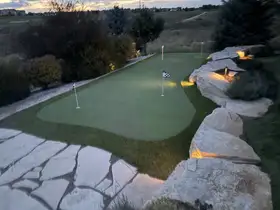
Take a 300 square foot backyard putting green on a Sunset Beach lot. The UDO's stormwater-plan trigger concerns an increase of more than 200 square feet in impervious coverage, not the area of turf ordered. If the complete installation qualifies for North Carolina's built-upon-area exclusion, that 300 square foot footprint does not automatically add 300 square feet of impervious coverage. If it is classified as impervious and replaces a pervious area, the resulting increase would cross the stated trigger. Have the town confirm the classification, any zoning permit and the survey or drainage documents needed for the whole proposal.
Sunset Beach also has the cleanest written route in this market, one that does not require arguing preemption: its impervious surface definition admits alternative materials on a letter under seal from a licensed and certified North Carolina professional engineer certifying hydraulic conductivity of 1.41 inches per hour or greater. For the Little River comparison, first verify the parcel’s jurisdiction. On an unincorporated Horry County lot, ask the county about the full excavation, grading and drainage scope. A small putting-green footprint does not establish that no stormwater plan or survey is needed. Surface classification and construction approval are separate questions.
Confirm the permitting office for your parcel
County and municipal boundaries determine which office reviews the work. Our research covered Horry and Brunswick provisions; it did not settle Georgetown County's or Columbus County's impervious-surface requirements. A Murrells Inlet mailing address alone does not establish the permitting jurisdiction. Check the parcel record and contact the county or municipality responsible for that address before planning excavation or calculating impervious coverage.
On the North Carolina side the statute runs ahead of the local paperwork, so expect friction at the counter. Brunswick County's stormwater ordinance still defines built-upon area with the pre-2024 exclusion list and never mentions artificial turf. The Shallotte UDO, amended through April 2026, has still not conformed its definition either, and its built-upon area definition covers "recreation facilities," a phrase a reviewer could reach for on a putting green. Neither ordinance overrides subsection (d), but both mean the reviewer is reading the statute against a local definition that has not caught up.
Where the North Carolina exemption stops: the 30-foot buffer
The exemption is not a license to lay turf anywhere in North Carolina. In September 2021 the Coastal Resources Commission voted 10 to 1 to prohibit artificial turf within the 30-foot coastal shoreline buffer.
CAMA jurisdiction turns on location, not activity. Under 15A NCAC 07H .0209(a) the estuarine shorelines AEC runs 75 feet landward of normal high water or normal water level, and 575 feet where immediately contiguous to Outstanding Resource Waters. Inside it, .0209(d)(2) caps impervious surfaces at 30 percent of the AEC area of the lot, unless the applicant can demonstrate through innovative design that the protection provided would equal or exceed the protection by that 30 percent limitation. Excavation, filling, and clearing or alteration of land as an adjunct of construction all fall inside the CAMA definition of development, so in an AEC a CAMA permit comes before the first shovel.
One question is still open. G.S. 143-214.7D(b) is written for the purposes of implementing State or local government stormwater programs. The 30 percent AEC cap is a Coastal Resources Commission use standard, not a stormwater program. Nothing in the sources on this page settles whether the turf exemption reaches it, so on an AEC lot, ask for a written determination before work starts.
Common questions
Do I need a permit to install artificial grass?
First confirm how the complete installation will be classified. Sunset Beach's stated permit and stormwater-plan triggers concern increases in impervious coverage; a qualifying turf system's footprint is not automatically an impervious increase. For an unincorporated Horry County lot, ask the county about the full excavation, grading and drainage proposal. On a coastal lot, confirm CAMA requirements before land alteration begins.
My town says turf counts as impervious. Can they?
In North Carolina, G.S. 143-214.7D(d) bars a local government from enacting, implementing or enforcing an ordinance, comprehensive plan or stormwater program with a built-upon area or impervious surface definition that does not comply with subsection (b). Several local codes here have not been updated — Brunswick County's stormwater ordinance and the Shallotte UDO both still omit turf — but an out-of-date ordinance does not change the statute. In South Carolina there is no such preemption, because there is no state exemption to preempt with.
Does turf count against my impervious limit in Horry County?
There is no written answer we could find. None of the Horry County, Myrtle Beach or North Myrtle Beach provisions we read names artificial turf, and the county's January 2024 stormwater design manual does not mention it in 134 pages. Sec. 17.7-16 does name compacted gravel and soil surfaces and fabric or plastic coverings as impervious, which is a fair description of what a turf system is built from. On a commercial property, ask Horry County Stormwater for a written determination before you sign a contract.
Can I put turf on a waterfront lot in Brunswick County?
Not inside the 30-foot coastal shoreline buffer — the Coastal Resources Commission voted 10 to 1 in September 2021 to prohibit it there. Outside the buffer, the state built-upon-area exemption is a real advantage on a tight coastal lot. Whether that exemption reaches the separate 30 percent impervious cap inside a CAMA Area of Environmental Concern is an open question the sources on this page do not settle, so on an AEC lot, get a written determination first.