Lawns
Is artificial turf worth it for a Florida yard?
The short answer
Is artificial turf worth it for a Florida yard?
It may be worthwhile for a defined lawn, pet area or putting green if the surface fits the way you use the yard and the care you can provide. Balance reduced grass maintenance against heat, cleaning, installation and eventual replacement. A wet or exposed area still needs those conditions addressed in the plan.
What a Florida lawn asks of you
Start with what you’d be giving up. A St. Augustinegrass lawn needs a steady routine, according to UF/IFAS Extension:
- Water: ½ to ¾ inch per application, whenever the blades start to fold, wilt or turn blue-gray.
- Mowing: typically every week in the growing season, at 3.5 to 4 inches for standard varieties.
- Fertilizer: 2 to 4 pounds of nitrogen per 1,000 square feet a year in north Florida.
- Pests and disease: chinch bugs, plus large patch and gray leaf spot.
Chinch bugs are the big one. UF/IFAS calls the southern chinch bug “the most important insect pest of St. Augustinegrass in Florida.” Infested grass “turns yellow, then a burnt-reddish color, and dies,” and in northern Florida, severe damage runs from April through October (UF/IFAS).
And the watering rules keep tightening
Even when you want to water, you often can’t. The St. Johns River Water Management District allows lawn watering twice a week during daylight saving time and once a week from November to March, never between 10 a.m. and 4 p.m. A water shortage order in 2026 cut that to one day a week (St. Johns County). Clay County Utility Authority says the restrictions cover every irrigation source, “including potable water, private wells, pumps, ground water, and surface water” (CCUA).
A lawn that needs ½ inch at a time, with one watering day a week in summer heat, is hard to keep green.
What turf takes off the list
Most of that routine goes away. “Synthetic turf systems do not require supplemental irrigation” and “do not require fertilization,” as UF/IFAS puts it. There’s nothing to mow and no grass for chinch bugs to eat.
It also works where grass won’t. UF/IFAS notes that Floratam, a common St. Augustinegrass variety, “does not persist well in environments that receive less than 6 hours of sunlight daily.” Under big oaks, in side yards and in dog paths, turf stays green where grass has already given up.
What it adds
Turf isn’t maintenance-free. Here’s what you take on instead.
- Heat. UF/IFAS reports natural lawns as much as 100°F cooler than synthetic turf, and one of its authors measured turf surfaces as high as 160°F. Shade is the fix that works. The numbers are in how hot artificial turf gets.
- Some water after all. People spray turf to cool it before use, and “many manufacturers recommend weekly wash downs,” according to UF/IFAS. Pet areas need a regular rinse.
- Light upkeep. UF/IFAS Extension lists periodic brushing and infill replacement, and falling leaves still have to come off.
- A finite life. UF/IFAS puts it at “perhaps 10 to 20 years depending on the quality of ongoing care,” after which the turf is removed, most likely to a landfill.
- No Florida-Friendly credit. “Because synthetic turf is not alive, it does not meet the criteria of a plant choice for an FFL landscape,” UF/IFAS states. It doesn’t feed pollinators or wildlife either.
Rinsing cools it, briefly
On a hot afternoon, a quick rinse makes turf usable for a few minutes. In a Brigham Young University study, watering dropped a synthetic surface from 174°F to 85°F, but it read 120°F five minutes later and 164°F after twenty. Penn State researchers found that watering before dawn had little effect on the surface by the afternoon.
So plan shade for the places people sit and play, and treat the hose as a quick fix before a game, not a cooling system.
Florida rules to plan around
Three rules shape a Florida install:
- Infill. On a single-family lot of an acre or less, the 2026 state standard allows clean silica sand, rock, shell or other natural material, and keeps rubber to the footprint of playground equipment. It also bans heavy metals and intentionally added PFAS in the turf system (Rule 62-308.100). Our Florida infill guide covers the details.
- Local bans. Cities and counties can’t ban turf on a single-family lot if it meets that standard (Fla. Stat. 125.572).
- Your HOA. An association can’t restrict turf that isn’t visible from the frontage, a neighbor’s lot, a common area or a community golf course (Fla. Stat. 720.3045). A front yard is a different conversation.
The ground decides how well it works
Most of the mapped ground in Duval, St. Johns and Nassau counties is poorly or very poorly drained: 71.4, 78.5 and 82.2 percent of mapped acres (USDA). Jacksonville gets roughly 28.8 inches of rain from June through September in a normal year (NOAA).
Turf drains, but that water still has to go into the ground. On a wet lot, the base is where the job succeeds or fails. How that works is in does rain drain through artificial turf.
When it’s worth it, and when it isn’t
It usually pays off:
- in shade where grass keeps dying,
- in dog yards that turn to mud,
- where watering days have left you with a brown lawn,
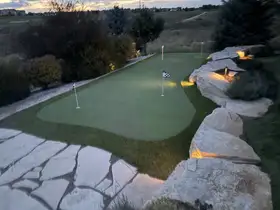
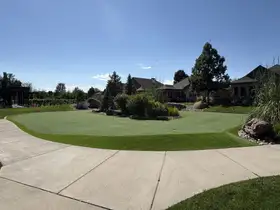
- and for a backyard putting green.
Think twice:
- for a full-sun play area with no way to add shade,
- if a living, wildlife-friendly yard matters to you,
- or on a low spot that floods, unless the drainage is fixed first.
Deciding for your yard
- Mark where the afternoon shade falls in July.
- Note where water stands after a summer storm.
- Check your HOA’s rules if any turf will be visible from the street.
- Decide what the space is for: play, pets, putting, or just looks.
- Book the free visit. We measure, check the ground, and draw a layout you approve before anything starts.
Common questions
Is artificial turf Florida-Friendly Landscaping?
No. UF/IFAS Extension states that because synthetic turf is not alive, it doesn't meet the criteria of a plant choice for a Florida-Friendly landscape. That matters if you're counting on Florida-Friendly law to get turf past an HOA. The law that names artificial turf is Fla. Stat. 720.3045.
Can my city or county ban artificial turf?
Not on a single-family lot of an acre or less, if the turf meets the state standard. Fla. Stat. 125.572 and Rule 62-308.100, in force since 19 May 2026, protect compliant turf from local bans. They don't cover HOA rules.
Does artificial turf get too hot in Florida?
In full sun, yes. UF/IFAS reports natural lawns as much as 100°F cooler than synthetic turf, and one of its authors measured turf as high as 160°F. Shade is the fix that works: put play areas and dog runs where the afternoon shade falls.
Do I still need to water artificial turf?
Not to keep it alive. You'll still use a hose now and then: to rinse pet areas, to cool the surface before play on a hot day, and for the weekly wash-down that UF/IFAS says many manufacturers recommend.