Lawns
Should you overseed your lawn with ryegrass for winter color?
The short answer
Should you overseed your lawn with ryegrass for winter color?
For most Grand Strand and Northeast Florida lawns, no. Clemson and NC State Extension advise overseeding only bermudagrass, because the extra water, fertilizer and shade from ryegrass can set back centipede, zoysia and St. Augustine in spring. On bermudagrass it means frequent watering to start, mowing as often as weekly through winter and a careful spring transition. Artificial turf needs no seed, fertilizer or mowing to look the same all winter, but it still needs leaves cleared and runs hot in summer sun.
A brown lawn in winter is normal
Bermudagrass, centipedegrass, zoysiagrass and St. Augustinegrass are warm-season grasses. NC State Extension says they grow most in summer, go dormant at the first heavy frost, turn brown, and green up slowly the next spring.
Each does it a little differently. UF/IFAS Extension says zoysiagrass is the first lawn grass to go off-color in fall and the last to green up in spring, and that St. Augustinegrass goes dormant in parts of Florida and stays brown or tan until spring.
None of that means the lawn is sick. An older UF/IFAS fact sheet on overseeding says it plainly: winter dormancy is a natural process, and there is nothing wrong with the grass.
Overseeding sows a temporary cool-season grass, almost always ryegrass, into the dormant lawn for winter color. Clemson Extension notes that golf courses and sports fields do it to handle winter traffic, while home lawns do it mainly for looks, and it does not recommend the practice for healthy, well-established warm-season lawns.
Only bermudagrass should be overseeded
Clemson and NC State draw the same line:
- Clemson Extension says overseeding home lawns is not generally recommended, and if it is done, it should be on bermudagrass only. The extra irrigation, fertilizer and shade that come with ryegrass will severely set back or damage centipedegrass, zoysiagrass and St. Augustinegrass in spring and early summer.
- NC State Extension says some homeowners have used annual ryegrass for winter color on bermudagrass, and that it is never recommended for overseeding other warm-season grasses.
Centipede shows why. Ryegrass needs nitrogen to stay green through winter, and UF/IFAS warns that overfertilizing centipedegrass with nitrogen reduces its cold tolerance and is believed to contribute to centipedegrass decline, which leaves patches of dead lawn in spring.
Bermudagrass isn’t immune either. Clemson says overseeding can hold it back too unless the spring is managed well, because ryegrass competes with it for moisture, sunlight and nutrients. If you aren’t sure which grass you have, find out before you buy seed.
What a winter of ryegrass asks of you
Clemson’s guide for bermudagrass shows the work involved:
- Preparation. Mow the lawn closely and clear excess thatch so seed reaches the soil. Clemson’s extension agent warns against going as far as scalping: it strips more than half the grass’s leaf area, the grass draws down the reserves stored in its roots, and the lawn goes into dormancy weaker.
- Seed. About 5 pounds of ryegrass per 1,000 square feet into an established lawn, half sown in one direction and half at right angles.
- Water. Light watering two or three times a day until the seed sprouts, then only as needed to keep the ryegrass from wilting. Too much washes seed away and invites disease.
- Fertilizer. Half a pound of nitrogen per 1,000 square feet after the second mowing, and another half pound in midwinter if needed. Clemson warns that overwatered, overfertilized ryegrass is prone to Pythium blight, especially in warm, humid weather.
- Mowing. Cut it to 1 to 1½ inches whenever it reaches 2 to 2½ inches. Well-fed ryegrass may need mowing every week, in months a dormant lawn would sit still.
- Next year. Once you start, Clemson says you will need to keep overseeding, because seed that didn’t sprout can come up later in weedy clumps. Stopping takes a fall preemergent herbicide.
In Northeast Florida, check the watering rules first
Those first weeks need frequent water. When we checked in October 2026, St. Johns County said the St. Johns River Water Management District declared a Phase III water shortage beginning May 11, 2026. Under that order, landscape irrigation is limited to one day a week, with none between 8 a.m. and 6 p.m., and additional restrictions apply to new sod and landscape plantings.
The county’s standard rules let new landscape be watered at any time for the first 30 days and every other day for the next 30. The page doesn’t say whether seed sown into an existing lawn counts as new landscape. Ask your water utility before you plan on watering every day.
Spring is when the lawn pays
Clemson Extension explains that ryegrass thrives in mild weather and competes with the waking warm-season grass for water and nutrients, which delays green-up. In a wet, cool spring it can persist and permanently damage the lawn. If the ryegrass isn’t mowed down as the permanent grass comes out of dormancy, it can shade it out.
Clemson adds that perennial ryegrass usually lives much longer into early summer than annual ryegrass, especially in shade, and can survive for years in parts of a lawn as a nuisance.
To push the ryegrass out:
- Stop feeding it. Clemson says the last application should go down by mid-to-late January. In Florida, UF/IFAS says no fertilizer after February in South Florida or after March in North Florida.
- Keep the lawn on the dry side, without letting the permanent grass suffer from drought.
- Mow the ryegrass low. Clemson says to take it down to about 1 inch, without scalping the permanent lawn.
- Be ready for a stubborn year. An NC State Extension agent adds that after a wet, cool spring you may need a herbicide to kill the ryegrass. Left alone, it survives in islands that look unsightly and are a pain to mow.
If you have bermudagrass and still want green
- Grand Strand: Clemson says to overseed about 30 days before the first frost, when daytime highs are near 70°F and nights are usually above 50°F. In South Carolina’s Midlands and Coastal regions, that is usually late October.
- Northeast Florida: UF/IFAS’s fact sheet says to wait until daytime temperatures are consistently in the low to mid 70s, and gives October to early November for North Florida.
- Annual or perennial: Clemson rates perennial higher for quality and disease resistance, but it lingers longer in spring. Annual is cheaper and coarser, and dies out sooner.
- Go light on seed. Clemson’s 5 pounds per 1,000 square feet is meant to give green cover without a stand so thick it causes transition problems in spring.
What changes where the lawn is turf
Artificial turf is not alive, as UF/IFAS Extension points out, so it has no dormancy to cover. The whole overseeding calendar drops away: no seed, no establishment watering, no winter fertilizer, nothing to mow and no spring transition. UF says synthetic turf needs no supplemental irrigation and no fertilizer.
It has its own list instead:
- Leaves. UF notes that leaves falling on synthetic turf still have to be removed to prevent wear. The routine is in keeping leaves and pine needles off turf.
- Rinsing. UF says many manufacturers recommend weekly wash-downs to remove dust and pet waste.
- Summer heat. UF reports synthetic turf surfaces measured as high as 160°F, far hotter than living grass. Our post on how hot turf gets covers what helps.
- Replacement. UF puts its life span at perhaps 10 to 20 years, depending on care.
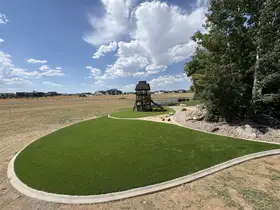
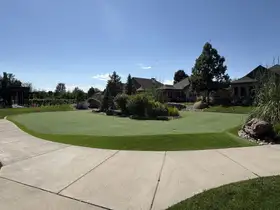
That makes turf a fit for part of a yard, not a blanket answer. A brown lawn in January is fine to look at. Where it is a problem, like the play area, the dog’s route or the strip beside a patio you use all winter, artificial turf for your yard keeps that spot the same all year, and the rest can green up on its own in spring. For the wider comparison, see artificial turf vs sod.
Denver lawns are a different question
A Denver lawn of Kentucky bluegrass, ryegrass or tall fescue is a cool-season lawn. NC State describes cool-season grasses as growing most in spring and fall and staying reasonably green in winter. Colorado State University Extension times the last fall fertilizer for October or November, while the grass is still green. There is no brown warm-season lawn to cover.
Overseeding there is a way to thicken a thin lawn, and CSU says cool-season grasses are easier to establish in late summer. Warm-season buffalograss is usually seeded in May or June.
The late-October question in Denver is water. CSU says there is often little or no snow cover from October through March, and lawns can be damaged without extra water. New lawns are especially at risk, and more so on south- or west-facing ground. Water only when air and soil are above 40°F with no snow cover, at midday so it soaks in before night. Turf takes that job off the list; caring for turf in a Colorado winter covers what it needs instead.
A five-minute decision
- Name your grass. Bermudagrass is the only lawn grass Clemson and NC State leave open to overseeding.
- Centipede, zoysia or St. Augustine: let it go brown. It greens up again in spring.
- Bermudagrass: overseed only if you will mow weekly through winter and manage the spring transition.
- In Northeast Florida, confirm your watering days before you seed.
- Spots you use all year are where turf earns its place.
- In Denver, skip the ryegrass and plan for winter watering.
- Book the free visit. We measure the space and check the ground, and we can walk the yard with you to decide which parts suit turf and which can stay grass.
Common questions
Can I overseed St. Augustine, centipede or zoysia grass?
Extension advice says no. Clemson Extension says overseeding should only be done on bermudagrass, because the extra water, fertilizer and shade from ryegrass severely set back or damage centipedegrass, zoysiagrass and St. Augustinegrass in spring and early summer. NC State Extension says annual ryegrass is never recommended for overseeding warm-season grasses other than bermudagrass.
When do people overseed on the Grand Strand and in Northeast Florida?
Late fall. Clemson Extension puts it about 30 days before the first frost, which is usually late October in coastal South Carolina. An archived UF/IFAS fact sheet gives October to early November for North Florida, once daytime temperatures are consistently in the low to mid 70s.
Is annual or perennial ryegrass the better pick?
Each has a catch. Clemson Extension rates perennial ryegrass higher for lawn quality and disease resistance, but it lives much longer into early summer and can hang on for years in parts of a lawn. Annual ryegrass is cheaper, lighter green and coarser, and dies out sooner in spring. UF/IFAS puts annual ryegrass at about a third of the price of perennial.
What happens if I overseed once and then stop?
Expect some ryegrass to come back. Clemson Extension says seed that did not sprout one year can germinate later and grow into weedy clumps. Once you stop, a previously overseeded lawn needs a fall preemergent herbicide to keep leftover seed and winter weeds from coming up.
Does artificial turf need anything in winter?
Mostly leaf clearing. UF/IFAS Extension notes that leaves falling on synthetic turf still have to be removed to prevent wear and tear. It needs no seed, fertilizer or supplemental irrigation. The routine is in keeping leaves and pine needles off turf.
Should a Denver lawn be overseeded for winter?
Not for winter color. Kentucky bluegrass, ryegrass and tall fescue are cool-season grasses, and Colorado State University Extension times the last fall fertilizer for October or November, while the grass is still green. CSU says cool-season grasses are easier to establish in late summer. In late fall the job is watering during dry spells with no snow cover.