
Dakota Ridge, CO
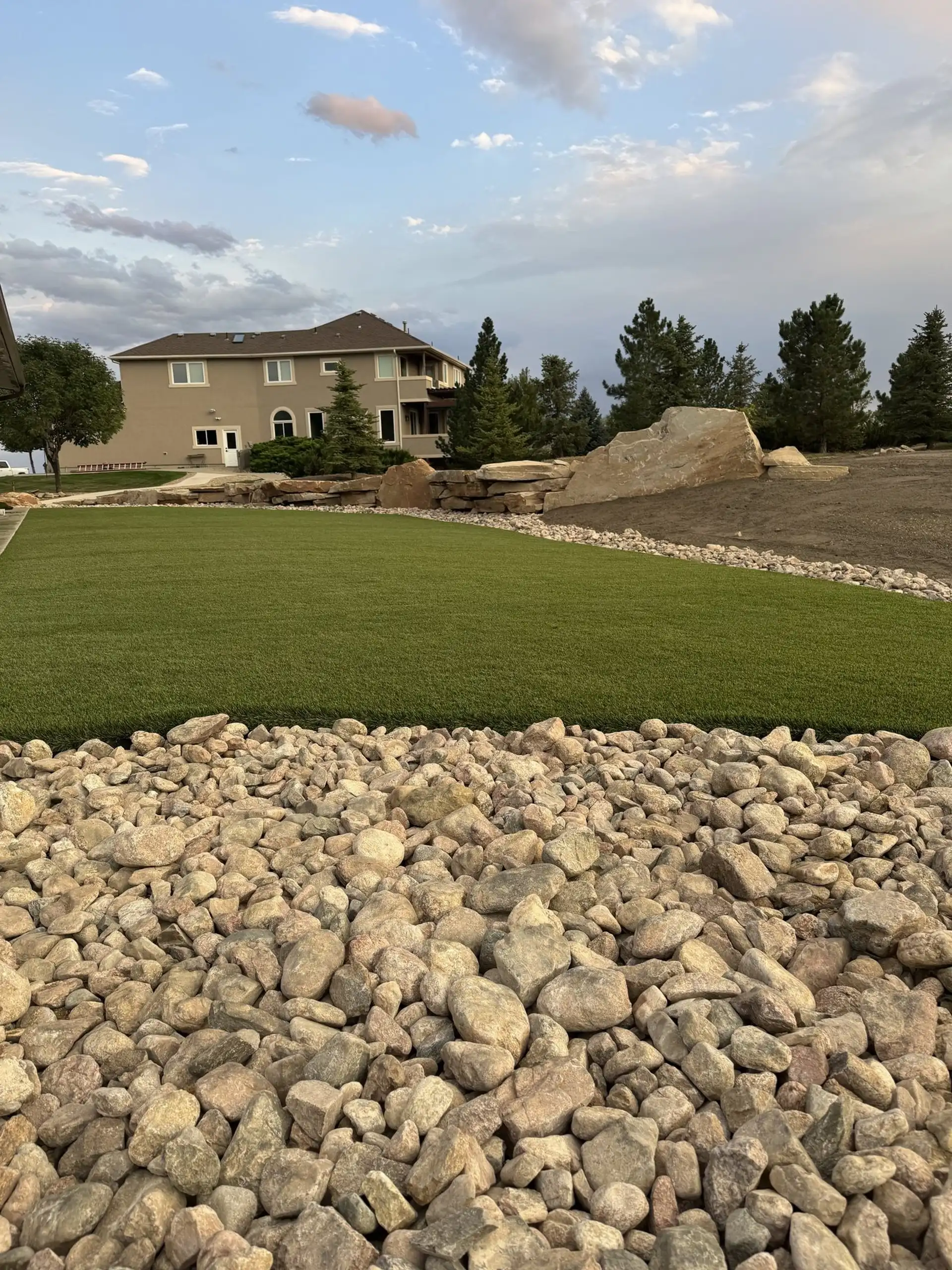
Artificial turf in Dakota Ridge, CO, planned around the county's 2026 wildfire code.
Pulling a county permit in the wildfire overlay? We keep the first 5 feet from the house turf-free and start the lawn beyond it. Free visit first.
- Turf kept clear of the 5-foot zone where the code applies
- A base built for the ground below the hogback
- A custom layout you approve before work starts
- Layout approved before installation
- American-made turf
- Free estimates, no pressure
The short answer
Does Jefferson County's wildfire code affect artificial turf in Dakota Ridge?
Only when a county permit applied for since 1 July 2026 brings it in. In the wildfire overlay, a new house, addition, deck rebuild or re-siding 25 percent or more of the walls requires noncombustible ground in the first 5 feet, where turf isn't listed.
Before you install in Dakota Ridge
What to know in Dakota Ridge.
The rules in short. We measure and check the ground at a free visit, then draw a layout that fits.
-
Wildfire Resiliency Code
A permit in the wildfire overlay, like a new house, addition or deck rebuild, brings a 5-foot noncombustible zone against the house. Turf isn't on the allowed list, so we start it beyond that band.
See the rule on wildfire resiliency code
Pull a permit in the overlay, and turf starts 5 feet from the house.
Dakota Ridge has no city hall. It is an unincorporated community governed by Jefferson County, with Lakewood to the north, Ken Caryl to the south and the Dakota Hogback to the west (Wikipedia). The county rule that shapes a new yard most is its Wildfire Resiliency Code, which covers permits applied for on or after 1 July 2026 (Jefferson County Wildfire Resiliency Code).
The code isn't retroactive, and it only reaches parcels inside the county's Wildland-Urban Interface overlay. A permit is what brings it in: a new house, an addition, a deck rebuild or new siding. Replacing a beam, a post or 25 percent or more of a deck's joists makes it a rebuild, while new boards alone need no permit. Re-siding under 25 percent of the walls is exempt, and a re-roof brings no yard rules (Jefferson County). A turf lawn on its own isn't one of the triggers the county lists.
Once a permit brings the code in, Zone 1 is the first 5 feet out from the structure, and a deck counts as a structure. Sections 502.1.2 and 503.1.2 call for noncombustible, hard surface materials there, such as rock, gravel, sand, concrete, bare earth or stone and concrete pavers, and every planting and all combustible mulch come out (Wildfire Resiliency Code). Turf isn't on the list.
So we draw a band of gravel or pavers against the house and the deck, and start the turf beyond it. If you want turf closer, ask the county in writing before work starts. An alternative material has to be approved by the code official, and a refusal comes back in writing with the reasons (Wildfire Resiliency Code).
-
Class 1 or Class 2
Check the county's map to see whether your parcel is Class 1 or Class 2; both share the same 5-foot rule near the house. If a permit's coming, settle where turf stops before final inspection.
See the rule on class 1 or class 2
Find your parcel on the county's map before you draw the yard.
On the county's overlay map, dated February 2026, much of the ground between C-470 and Kipling Street, south of Quincy Avenue, is shaded blue for Class 1, with some blocks left white. West of C-470, up toward the hogback, the shading turns orange for Class 2 (WUI Overlay District map). The map carries no lot lines, so check your parcel on the county's interactive map or call Planning & Zoning on 303-271-8700 (Jefferson County).
Both classes share the 5-foot rule. From 5 to 30 feet, Zone 2 rules out juniper, arborvitae and Gambel oak, which is worth knowing where turf meets a planting bed (Wildfire Resiliency Code). Class 2 adds Zone 3, out to 100 feet, with tree crowns spaced apart (Jefferson County), and stretches Zone 2 standards 10 feet either side of the driveway (Zoning Resolution Section 39).
Defensible space is checked by a County-approved Wildfire Mitigation Specialist you hire: once to say what work is needed, and again when it's done. You pay for the inspections, the county adds no fee of its own, and a completed Defensible Space Permit stays valid for 3 years (Jefferson County; Section 39). If a permit is coming, settle where the turf stops before the final inspection.
-
Dipping bedrock
Along C-470, heaving bedrock can raise ridges up to two feet high when it gets wet. We check your ground's fall and shape the base to send water away from the foundation.
See the rule on dipping bedrock
On the west side, the rock under the yard stands on edge.
C-470 runs through the western part of Dakota Ridge (Wikipedia), and the county maps a Designated Dipping Bedrock Area along it. The area's western edge follows the top of the Dakota Sandstone on the hogback's eastern dip slope, and the layers beneath it tilt east or northeast at 30 to 90 degrees from horizontal. The guide's map, revised 29 August 2024, draws the band along C-470 from south of Morrison toward Littleton (Designated Dipping Bedrock Area Guide).
The hazard there is heaving bedrock. Ridges as large as two feet high form where neighboring layers, each with a different potential to swell, get wet. The county sees damage typically within ten years of development, the ground can keep moving for years or decades, and the pattern is erratic: a damaged house can sit next to homes with no damage at all.
Existing subdivisions are exempt from most of the overlay's rules, though a large addition or structural repair can bring foundation-design standards and a Building Safety review. Ask Planning & Zoning whether your lot falls inside the area (Jefferson County).
For turf, the lesson is water. At the free visit we check the ground and which way it falls. The base is built for your soil and shaped to send water away from the foundation, not into the ground beside it. Point out any cracked or lifted paving before we lay out a putting green, where a true roll matters most.
-
Water
Check which district bills you. On a Lakehurst bill, grass watering is prohibited after September 30, with fines up to $2,000 for spray irrigation; an artificial lawn has no sprinkler season to lose.
See the rule on water
The district on your bill sets the surcharge and the season.
Outside Denver, Denver Water sells through distributors. A Master Meter distributor reads its own customers' meters and bills them on rate schedules it sets itself (Denver Water). Lakehurst Water and Sanitation District is one, and its district map takes in neighborhoods south of Quincy Avenue between Kipling Parkway and C-470 (Lakehurst Water).
On a Lakehurst bill, residential use above 5,000 gallons a month carries a drought surcharge of $1.65 per 1,000 gallons, charged from June for May use. Grass watering is prohibited after 30 September 2026. Spray irrigation after that date is a willful violation, with fines up to $2,000, and the restrictions and surcharges run through 30 April 2027 (Lakehurst Water). An artificial lawn has no sprinkler season to lose.
Not every Dakota Ridge bill comes from Lakehurst. Southwest Metropolitan Water and Sanitation District serves parts of eastern Jefferson County and asks you to call 303-979-2333 to confirm whether an address is inside its boundary (Southwest Metro Water). Read the district name on your bill before you copy a neighbor's watering days, and read our guide to water rebates and turf before you count on money back.
What we install in Dakota Ridge
Choose your turf project.
Plan a lawn, putting green or dog run with the 5-foot band, the base and the drainage drawn in from the start.
-
Artificial lawns
Spend less time mowing, with an artificial lawn planned around your yard and its use.
See artificial lawns -
Putting greens
Practice your putting right outside your back door.
See putting greens -
Pet turf
A dog run or pet lawn planned around drainage, secure edges and regular cleaning.
See pet turf
FAQ
Turf questions in Dakota Ridge.
Who installs artificial turf in Dakota Ridge, CO?
We install artificial turf, pet turf and backyard putting greens in Dakota Ridge, CO, with 13 years' experience. Start with a free visit to measure and check the ground, then a custom layout you approve before work starts. Call 303-349-2368.
How do I find out if my lot is in the wildfire overlay?
Look it up on the county's interactive WUI map. Light or dark blue means Class 1, orange means Class 2, and the map covers only unincorporated Jefferson County (Jefferson County). If you think the line is wrong, you can take forestry and topographic evidence to the Director of Planning and Zoning. The director can't shift the mapped line, though; moving it takes the Board of County Commissioners (Section 39).
Do Lakewood's or Ken-Caryl Ranch's rules apply in Dakota Ridge?
Lakewood's city code doesn't, because Dakota Ridge is governed by Jefferson County. Ken-Caryl Ranch's turf standards bind homes inside the Ranch; if your covenants name the Ranch, start with our Ken Caryl page. Otherwise it's the county's rules, plus any covenants your own subdivision has.
Should I have the house checked if I'm buying in Dakota Ridge?
The county suggests it inside the dipping bedrock map area. Its guide says a buyer of an existing home there, or in any other expansive soil area, may want an engineer to evaluate the house to make sure it is structurally sound (Designated Dipping Bedrock Area Guide). That's separate from the turf base, which we plan after checking the ground at the free visit.
Nearby areas we cover
Free estimate
Your free estimate in Dakota Ridge.
Tell us about your project and we’ll call to arrange a free visit.
Or call 303-349-2368
Your free estimate includes
- A visit to measure your space
- A custom layout, drawn for your space
- Turf options, side by side
- A written price, with no pressure to sign
Five short steps. We’ll call to arrange your visit.