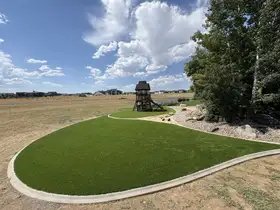
Putting greens
How do you care for a backyard putting green?
The short answer
How do you care for a backyard putting green?
Keep debris off the green, follow the product’s brushing instructions and inspect seams, edges and cups. If the ball starts rolling differently, clear the surface and note where it changes before adding infill or adjusting anything. Ask the installer for a care routine suited to the actual green and use.
A green needs care, just not the kind grass needs
A backyard synthetic green needs no mowing or irrigation for growth. Cleaning and occasional cooling can still use water. What it does need is light, regular attention, because three things decide how it plays: a clean surface, level infill, and fibers that stand up.
Here is the routine in short:
- Every week or two: clear leaves and debris, and look over the cups and edges.
- Every month or so, more with heavy use: brush the green.
- When the roll changes: check the infill and top up low spots.
- Once a year: check every seam and edge.
Keep the surface clear
Leaves, twigs, seed pods and grit all knock a putt off line. Clear them often, especially in fall.
A leaf blower is the quick way, but use it gently. New Jersey’s environment department summed up the research on turf fields in 2025. It lists leaf blowing, compared with raking, among the habits that carry infill and plastic particles off the surface. On a putting green, infill you blow away changes how it rolls. Blow leaves off from a distance, and rake or brush where you can.
Deal with sticky messes quickly. The Synthetic Turf Council, the industry’s trade association, advises removing stains such as gum as soon as possible. For cleaning fields, it suggests a sweeper or vacuum with soft nylon brushes, which is a good rule for any tool that touches a green.
Brush to keep the roll true
Brushing does two jobs. The trade association’s guidelines say to brush periodically, depending on use, to even out low areas of infill and bring the fibers back upright.
Both matter for putting, because the infill and the brushing set the speed. A matted patch along your favorite line, or a low spot of infill, plays differently from the rest of the green.
Keep the brushing light. The New Jersey report notes that brushing and grooming add their own wear to the fibers. So brush often enough to keep the surface even, with a stiff broom or turf brush, but don’t scrub.
Watch the infill: it sets the speed
On a putting green, infill and brushing set the speed, and the shaping of the base sets the break. The shaping stays put. The infill does not.
On sports fields, the New Jersey report cites infill losses equal to about 0.8 mm of depth a year after the third or fourth year. It puts those losses down to use, maintenance, runoff and snow removal, and a backyard green sees all four. The report also says regular decompacting helps infill keep performing and slows that loss.
What to do about it:
- Look for low spots, where the fiber tips stand taller or the base shows through.
- Brush first. Often the infill has just moved, not gone.
- Top up only where it is still low after brushing, a little at a time, and brush it in.
- Roll some putts across the area before you add more.
In Florida, the infill choice is set by rule on a single-family lot of an acre or less. Rule 62-308.100 allows clean silica sand, rock, shell or other natural material, with rubber only under playground equipment. Our Florida infill guide covers the rule.
If you want to understand speed itself, and what number to aim for, our post on how fast a putting green should roll covers it.
Cups, fringe and chipping
Wear gathers where the play does. The turf around each cup takes more feet and more balls than the rest of the green, so look it over when you clear debris.
If you chip onto the green, a separate chipping area keeps the wear off your cups. An infilled surface and a fringe hold chip shots better than bare turf.
Seams and edges
A putting green’s seams have to be tight and flat, because a ball feels every ridge. The trade association suggests inspecting seams and other installation features at least once a year. It also says a seam that opens or comes loose may need quick, temporary gluing until it can be fixed properly.
Don’t wait on a lifting seam. Once an edge rises, infill and water get under it and it keeps opening.
Weather: sun, heat and snow
Sun. UV light is what breaks turf fibers down over time, the New Jersey report says. You cannot brush that away, so it is worth weighing when you decide where a green goes.
Heat. Synthetic turf gets hot in full sun. Brigham Young University measured a daytime average of 117°F. Consider times with less sun exposure, plan shaded seating and check actual conditions before playing. Neither shoes nor time of day establishes that a sunny green will be comfortable. A rinse cools it only briefly: in the same study, watering dropped the surface from 174°F to 85°F, but it was back to 120°F five minutes later.
Snow. In the Denver metro, let snow melt off the green where you can. The New Jersey report lists careless snow clearing and piling among the ways infill leaves a field, and every scoop that scrapes the surface takes some with it.
A simple care calendar
- Weekly in fall, every couple of weeks otherwise: clear debris gently.
- Monthly, or after heavy use: brush the whole green lightly.
- When putts start behaving differently: brush, then top up low spots.
- After storms: check the edges and look for washed infill.
- Once a year: inspect every seam and the edges around the fringe and cups.
When we finish a putting green, we walk you through the care it needs, so you know what your green’s infill and brushing should look like from day one.
Common questions
How often should I brush a putting green?
As often as its use calls for. The Synthetic Turf Council's guidelines say to brush periodically, depending on use, to even out low spots in the infill and stand the fibers back up. Keep it light: New Jersey's environment department notes that brushing and grooming add wear too.
Why does my green roll differently than it used to?
Usually the infill. It is one of the two things, with brushing, that set a green's speed. Infill thins and packs down with use and weather, so a green that has gone months without brushing or a top-up will not roll the way it did. Even it out before you change anything else.
Can I use a leaf blower on a putting green?
Yes, gently. New Jersey's report lists leaf blowing, compared with raking, among the habits that carry infill and plastic particles off a turf field. Blow leaves off from a distance, and rake or brush where you can.
What infill can a putting green use in Florida?
On a single-family lot of an acre or less, natural infill only. Rule 62-308.100 allows clean silica sand, rock, shell or other natural material, with rubber allowed only under playground equipment. The install has to keep infill from washing off the property.