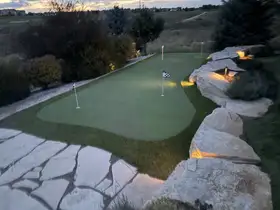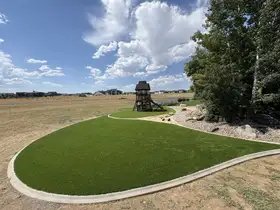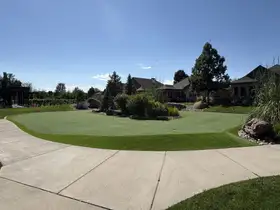
Putting greens
How many holes on a turf mini golf course have to be accessible?
The short answer
How many holes on a turf mini golf course have to be accessible?
At least 50 percent of the holes on a miniature golf course must be accessible, and those holes must run in one consecutive sequence with only one break allowed, ending at the last hole. Playing surfaces are exempt from the general ground-surface rule but must be stable, firm and slip resistant, with set limits on curbs, slopes and reach range at each hole.
The short version
The 2010 ADA Standards for Accessible Design set specific numbers for a miniature golf course, not just a general accessibility principle. At least half the holes have to be accessible, they have to run in sequence, and each accessible hole has its own rules for the surface, the curbs, the slope and how close a golfer using a mobility device can get to the ball. A family entertainment center, resort, campground or brewery adding a course needs those numbers before the layout is cut, not after.
This is a summary of the federal design standard, not legal advice. Confirm the current text with the U.S. Access Board or a qualified accessibility consultant before finalizing a layout, since state and local building codes can add requirements of their own.
How many holes have to be accessible
Section 239.2 of the 2010 ADA Standards sets the baseline: at least 50 percent of the holes on a miniature golf course must be accessible (U.S. Access Board). On a standard 18-hole course, that is a floor of 9 holes, not a target. Nothing stops a course from making more holes accessible, and doing so gives the layout more flexibility on which holes can sit at either end of the required sequence.
Section 239.3 adds the routing rule: the accessible holes must be consecutive. One break in that sequence is allowed, but only on the condition that the last hole in the sequence is also the last hole on the course. That single exception exists for practical reasons — a course does not have to end its accessible run mid-layout and then pick it back up somewhere that breaks the flow of the finishing holes.
What this means for a layout on synthetic turf:
- Plan the accessible sequence before cutting any turf, since retrofitting a scattered layout into a consecutive run after installation means moving holes.
- Nine holes is a floor for an 18-hole course, not the design answer for every property. A shorter course scales the same 50 percent rule.
- The one permitted break has a specific condition attached to it. A break anywhere else in the sequence does not meet the standard.
Playing surfaces get an exception, with a condition attached
Most of the 2010 ADA Standards’ ground and floor surface requirements assume a surface like a sidewalk or a ramp. A miniature golf hole is not that, and Section 1007.2 recognizes it: playing surfaces on a golf course or miniature golf course are exempt from the Standards’ general ground and floor surface requirement (U.S. Access Board).
The exemption is not unconditional. The Access Board’s guide describes the surface as still needing to be stable, firm and slip resistant. A synthetic surface built for putting play — the same base and turf specification used on a backyard or commercial putting green — is engineered to hold that combination without the wear patterns natural turf develops around a cup.
Curbs, slopes and the crossing points
Where an accessible route has to cross a hole’s playing surface, the standard allows a curb of up to 1 inch, provided the opening at that crossing is at least 32 inches wide. That is Section 1007.2’s second exception, and it is the detail that lets a course use a slight edge or lip at a hole crossing without failing the standard, as long as the opening is wide enough for a mobility device to pass through.
Slope gets its own exception too. A playing surface route can rise at a slope of up to 1:4 — 25 percent — but only for a maximum rise of 4 inches. Beyond that rise, the slope has to come back down to standard limits. A separate limit applies to landing areas, which the Access Board’s guide describes as capped at 1:20.
These numbers matter at the design table, not just at inspection. A hole with a mound, a ramp feature or an elevation change built into the theme has to keep that 1:4-for-4-inches ceiling in mind on any route a golfer using a mobility device would take through it.
Reach range: how close the route has to get to the ball
Section 1007.3.2 sets what the Access Board’s guide calls the “golf club reach range”: an accessible route has to run within 36 inches of any spot on the hole where the ball comes to rest. That includes the cup and any spot a design intentionally routes the ball to stop, such as a bank shot pocket or a themed obstacle.
In practice, this rule shapes hole geometry as much as it shapes the route. A hole designed so the ball can end up more than 36 inches from any accessible path does not meet the standard, regardless of how accessible the rest of the hole looks.
The start of play platform
Every accessible hole needs a place to tee off from that meets its own, tighter standard. Section 1007.3.1 requires a clear space of at least 48 by 60 inches at the start of play, sloped no steeper than 1:48. That slope limit is stricter than the 1:20 landing slope elsewhere on the course — 1:48 is close to level, which is the Standards’ general threshold for a surface that does not count as sloped at all.
That platform size and slope belong in the base preparation stage, before turf is cut to shape. A base built flat and to dimension under the tee-off area saves rework once the surface goes down.
What this means for commercial and hospitality builds
A family entertainment center, resort, campground or brewery building a course for guest use is the kind of project this standard is written for. The accessible-hole count, the consecutive routing, the curb and slope allowances, the 36-inch reach range and the 48-by-60-inch start platform all have to be worked into the layout before the first hole is cut, because moving a hole after the turf and base are in means redoing that section’s grading, not just its surface.
None of this substitutes for an evaluation by a qualified accessibility consultant for your specific layout, and it does not cover any state or local building code that applies on top of the federal standard. Confirm both before construction drawings are final.
Checklist before the layout is cut
- Count the holes and confirm at least 50 percent will meet the accessible standard — round up, not down.
- Map the accessible holes as one consecutive run, with at most one break, and only if that break ends at the course’s final hole.
- Specify a stable, firm, slip-resistant playing surface for every accessible hole.
- Keep any curb at a route crossing to 1 inch or less, with a 32-inch-minimum opening.
- Hold playing-surface slope to 1:4 for no more than a 4-inch rise, and landing areas to 1:20.
- Design ball-rest points within 36 inches of the accessible route on every accessible hole.
- Build each accessible hole’s start-of-play area to 48 by 60 inches minimum, sloped no steeper than 1:48.
- Confirm state and local building code requirements alongside the federal standard before drawings are final.
Common questions
Does every hole on a mini golf course need to be accessible?
No. The U.S. Access Board's guide to Chapter 10 states that at least 50 percent of the holes on a miniature golf course must be accessible under Section 239.2 of the 2010 ADA Standards. On an 18-hole course, that is a minimum of 9 holes. Building more than the minimum is allowed and can widen which holes a design can put first or last in the sequence.
Can the accessible holes be scattered around the course?
Not under the standard rule. Section 239.3 requires the accessible holes to be consecutive. One break in that sequence is permitted, but only if the last hole in the sequence is also the last hole on the course. A designer laying out an 18-hole course with 9 accessible holes has to plan the routing around that constraint from the start, not retrofit it later.
What counts as an accessible route on the playing surface itself?
Section 1007.2 exempts golf course and miniature golf playing surfaces from the general ground and floor surface requirement, but the exemption is not a blank check. The Access Board's guide describes the surface as still needing to be stable, firm and slip resistant. A synthetic surface built and seamed for that purpose is how a course meets the requirement without paving over the greens.
How close does an accessible route have to run to where the ball lands?
Within 36 inches. That is the "golf club reach range" the Access Board's guide describes under Section 1007.3.2 — an accessible route has to come within 36 inches of any area on the hole where the ball comes to rest, so a golfer using a mobility device can reach it without leaving the route.
What size platform does the start of each accessible hole need?
A clear space of at least 48 by 60 inches, sloped no steeper than 1:48, per Section 1007.3.1 as described in the Access Board's guide. That is the tee-off area, and it has to be closer to level than the rest of the course is allowed to be — the 1:48 limit is the standard's threshold for what still counts as a flat surface.