Costs and planning
Should you install artificial turf yourself or hire an installer?
The short answer
Should you install artificial turf yourself or hire an installer?
DIY depends on whether you can plan and carry out the complete installation, including preparation, drainage, seams and material handling. Hiring may be useful when the site or intended use adds complexity. Compare the same scope and include tools, disposal, time and any required specialist work.
What the job involves
On paper it’s four steps. The old grass comes out. A base is built and compacted for your soil. The turf is laid, seamed and edged. The infill goes in.
One state’s licensing board wrote those steps down as a standard. North Carolina’s rule for landscape contractors requires:
- a sub-grade that’s compacted and pitched to drain
- a perimeter attachment system to hold the turf
- the turf rolled out with the nap facing one direction
- an evenly weighted sand layer over the whole surface
- the manufacturer’s specifications, followed
Florida’s standard for single-family lots adds washed subgrade material, permeable layers from the turf down, no over-compacting of the soil beneath, and anchoring at every edge and seam. It says nothing about who does the work, so it applies to a weekend job too. Our Florida infill guide covers the rest of the rule.
Nothing on those lists is exotic. The work is in doing each one properly.
Before you dig: call 811
All three of our states require a locate request before digging, and it applies to you as much as to a contractor:
- Colorado: at least two full business days ahead, not counting the day you call. Colorado 811 lists landscaping among the projects that count, and says to call it yourself if in doubt rather than rely on a landscaper.
- Florida: at least two full business days, not counting weekends or holidays.
- South Carolina: at least three full working days ahead, and no more than 12.
Utilities mark only the lines they own. Sprinkler lines and landscape lighting are private, so finding them is on you.
The parts that decide how it turns out
The dig and the base. This is the heaviest part of the job, and the part you can’t redo without starting over. The ground decides the base. Across much of the Denver metro that means clay: the Colorado Geological Survey says swelling formations underlie all the major Front Range cities, and wet clay can expand up to 20% by volume. On the coast it’s often a high water table: under Leon fine sand, found in Horry County, the USDA puts the water table 6 to 18 inches down for one to four months in most years. And as New Jersey’s environment department points out, a turf that drains 10 inches an hour doesn’t make the ground under it drain that fast.
Where a rule gives a number, it’s specific. Thornton’s rebate rules, for one, require at least 3 inches of compacted aggregate under the turf. Compaction has a limit, too: Florida’s rule bars compacting the soil under the base to the point that water can’t percolate through it.
Seams. Two pieces have to meet so the join disappears, with the nap running the same way on both sides. Thornton’s rules require glued, not sewn, seams.
Edges. The turf has to be held down all the way around: a perimeter attachment in North Carolina’s standard, anchoring at every edge and seam in Florida’s. Loose edges are where dogs dig and feet catch.
Infill. It goes in evenly, in the amount the turf maker specifies. In Florida it has to be natural material such as clean silica sand, and the rule requires the installation to keep infill from washing off the property.
The rest of the yard. If the job touches a sprinkler line, a water line or lighting, those can be separate trades. Colorado has no state turf license, but it does license plumbing and electrical work at state level, according to its Division of Professions and Occupations.
If you hire
Check licensing against the complete work being offered. In South Carolina, Section 40-11-30 requires a license for general contracting when the total construction cost exceeds $10,000. That threshold does not classify every turf job as general contracting or settle requirements for work below it. Give South Carolina LLR the address, property type, scope and contract value, and confirm the applicable Board and classification, including any separate residential or specialty work. Our installer licensing guide explains the checks for each state.
Whoever you hire, get a written quote that names the base, the drainage, the turf, the infill, and how the seams and edges are held. Our guide to reading a turf quote goes line by line.
A fair way to decide
DIY makes sense when:
- the area is small, flat and simple in shape
- water doesn’t stand after a hard rain
- there’s no sprinkler system or lighting to reroute
- you have help, and a few weekends to give it
Hiring makes sense when:
- the ground is clay, wet or sloped
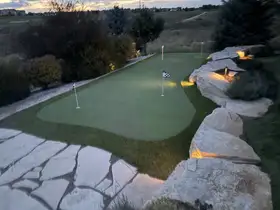
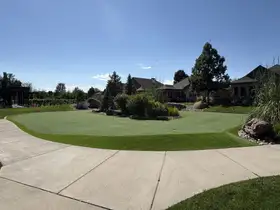
- it’s a dog run that has to drain, or a putting green where the shaping sets the break
- it’s a play area that needs a tested pad under the turf
- the area is large, or the seams will be in plain view
If you hire us, you get a free visit to measure and check the ground, a custom layout you approve before work starts, site prep and a base built for your soil, turf laid, seamed and edged, infill, finishing and cleanup, and a walkthrough of the care it needs, with 13 years’ experience behind it.
Before you start
- Call 811 with the notice your state requires, and find sprinkler and lighting lines yourself.
- Watch where water stands after rain.
- Plan the base for your soil, and write the depth down.
- Get the turf maker’s instructions for seams, edges and infill, and follow them.
- Plan seam placement and nap direction before you cut.
- Decide who handles irrigation and wiring.
If the ground turns out to be the hard part, book the free visit.
Common questions
Do I need to call 811 to put in artificial turf?
Yes, if you're digging. Colorado 811 says state law requires contacting it at least two full business days before you dig, and lists landscaping among the projects that count. Sunshine 811 asks for two full business days in Florida, and SC811 three full working days in South Carolina. Utilities mark only their own lines, so sprinkler and lighting lines are yours to find.
Can I lay turf over my existing grass?
Not if you want it to stay flat and drain. The written standards start below the lawn: North Carolina's licensing board requires a compacted sub-grade pitched to drain, and Florida's standard requires permeable layers over washed subgrade material. Turf laid straight over grass has neither.
Does Florida's turf rule apply if I install it myself?
It sets the standard for synthetic turf on single-family lots of one acre or less, and says nothing about who does the work: natural infill, permeable layers, washed subgrade material, and anchoring at edges and seams. DEP doesn't inspect, but the state's protection from local turf bans covers only turf that meets the standard.
When is hiring worth it?
When the ground is the hard part. That means clay that swells, which the Colorado Geological Survey says can expand up to 20% by volume when wet, a high water table, a slope, or a dog run that has to drain. The same goes for a putting green, where the shaping sets the break, and for a play area that needs a tested pad under the turf.