Local rules
In a CDD Community, Does the District or the HOA Approve Your Turf?
The short answer
In a CDD community, who approves a turf installation — the district or the HOA?
Usually the homeowners' or community association, not the district. The association's architectural review committee reviews what goes on your lot, including turf and landscaping. The community development district runs shared infrastructure and amenities, and under a 2026 Florida law can still enforce the community's deed restrictions. Confirm which body reviews your address before a layout is final.
Two different bodies, two different jobs
If your address sits inside a community development district, it’s easy to assume the district is who signs off on a turf project. Usually it isn’t.
A CDD is a unit of local government. It finances, builds and maintains the community’s shared infrastructure — roads, stormwater systems, parks, a clubhouse, a pool, sometimes a greenway trail — and it runs on an assessment that shows up on your property tax bill. An elected Board of Supervisors oversees it.
Your homeowners’ or community association is a different organization, usually a nonprofit corporation formed under Florida’s homeowners’ association law. It holds the declaration of covenants for your lot, and its architectural review committee is who decides whether your turf, paver, fence or landscaping plan fits the community’s rules.
The two can sit side by side in the same neighborhood. Knowing which one signs off on your lot, and which one just keeps the amenities running, saves a resubmission.
What a district actually does
The Tolomato Community Development District’s own guide to Nocatee lays out the pattern plainly: the district was established to plan, finance, construct and maintain public infrastructure and amenities, funded through a capital assessment for the bonds that built it and an annual operations and maintenance assessment for its parks, roadways and greenway system. Both appear on your property tax bill. A five-member Board of Supervisors, elected by property owners, oversees the district, and a district manager runs day-to-day operations.
Sampson Creek’s own Amenity Center Policies follow the same structure. They define “Board” as the District Board of Supervisors and “District Property” as everything the district owns — the amenity center, common areas, ponds. What they don’t cover is what an individual homeowner does on their own lot. That’s a separate document, held by a separate organization.
What the association’s architectural review committee does
At St. Johns Golf & Country Club, the body that takes up an individual lot is the community association, not the district. Its Architectural Review Application is addressed to the St. Johns Golf & Country Club Community Association, and it lists landscaping or removal of landscaping as one of the changes that needs approval — along with paint, pavers, fences and additions. The form asks for a survey of the current landscape and a copy of the proposed landscape plan, including the type and color of materials, before work goes forward.
That’s the pattern in most communities that also sit inside a CDD: the association’s architectural review committee (sometimes called an ARC or ARB) is who decides what your lot looks like. The district doesn’t touch that decision — it’s busy running the infrastructure everyone shares.
Where a putting green fits the same question
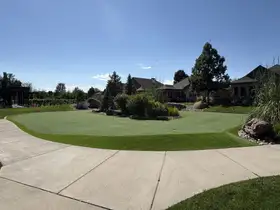
A backyard putting green raises the same approval question as turf on the lawn, and often a second one: cup and mound placement, and whether the green sits inside a golf-course sight line. If your community backs onto a course, the association’s guidelines may treat that differently from a green tucked against the house. Ask the same question you’d ask about turf — who takes it up — before you sketch the shape.
What changed in Florida law for 2026
Florida has been narrowing how much a local government can regulate synthetic turf on a single-family lot, once the Department of Environmental Protection’s statewide standard takes hold. CS/CS/SB 1180 addresses a question that follows from that shift: does the same limit reach a community development district enforcing its own deed restrictions?
The Senate’s bill analysis answers no. The bill “clarifies that the prohibition on local government regulation of synthetic turf does not limit a CDD’s ability to enforce deed restrictions.” It takes effect 1 July 2026. In plain terms: where a district in your community holds enforcement authority over deed restrictions, this bill keeps that authority in place even as the state limits what cities and counties can do to regulate turf directly.
That’s a narrow point. It doesn’t change who looks at your plan in the first place — for most homeowners, that’s still the association’s architectural review committee, not the district.
What a professional install still leaves to you
We don’t submit anything to an association, an architectural review committee or a district on your behalf. That paperwork, and the approval that comes back, is between you and the body that governs your lot. What we handle is the site itself: the free visit to measure the space and check the ground, a custom layout you approve, the base built for your soil, and the turf laid, seamed, edged and finished. Having your approval in hand before that visit keeps the layout we draw from needing a second round with your association.
If your community’s rules need to change
Turf rules written into a declaration don’t update themselves. Under Fla. Stat. 720.306(1)(b), a governing document may be amended by the affirmative vote of two-thirds of the voting interests, and under 720.306(1)(e) the amendment is effective once it’s recorded in the county’s public records. If your association’s rule on turf is the sticking point, that’s the process that changes it — not a request to the district, and not a one-owner exception.
What to settle before a layout is final
We measure your lot, check the ground, and draw a custom turf layout you approve before anything starts. Bring these answers to that visit:
- Do you sit inside a homeowners’ association, a CDD, or both? Check your closing documents or ask your property manager.
- Which body reviews landscaping on your lot? For most owners, that’s the association’s architectural review committee, not the district’s Board of Supervisors.
- Does the association’s ARC application ask for a current-landscape survey and a proposed plan? Have both ready before you submit.
- If the district enforces deed restrictions in your community, confirm that directly with the district manager — don’t assume either way.
- If the rule itself needs to change, that runs through a two-thirds vote and recording, not a single request.
If you’re near Nocatee or St. Johns, call us with your questions before you submit. Reach us at 303-349-2368 to set up your free visit.
Common questions
What's the difference between a CDD and an HOA?
They do different jobs. A community development district is a unit of local government that finances, builds and maintains shared infrastructure — roads, parks, stormwater systems, a greenway trail — funded by an assessment on your property tax bill and run by an elected Board of Supervisors, as the Tolomato Community Development District's own guide describes for Nocatee. A homeowners' or community association reviews what individual lots look like.
Does Florida's 2026 turf law change what my district can require?
It clarifies one thing. CS/CS/SB 1180, effective 1 July 2026, states that the law limiting local government regulation of synthetic turf does not limit a CDD's ability to enforce deed restrictions, according to the Florida Senate's bill analysis. Where a district holds that enforcement role in your community, the state's turf preemption doesn't take it away.
Who do I submit a turf or landscaping plan to?
In most communities, the association's architectural review committee, not the district. St. Johns Golf & Country Club's own Architectural Review Application is submitted to the St. Johns Golf & Country Club Community Association and asks for a survey of the current landscape plus the proposed landscape plan and materials before landscaping or removal of landscaping goes forward.
Can I find both bodies for my community in one place?
Not usually. The district's meetings, budget and Board of Supervisors are public record through the district itself, while the association's architectural guidelines and ARC contact are the association's own documents. Sampson Creek's Amenity Center Policies define its own District Board of Supervisors separately from the community association next door — ask your closing documents or property manager which one you have, and confirm directly with each.
Does an amendment to my community's covenants need a vote?
Under Fla. Stat. 720.306(1)(b), a governing document may be amended by the affirmative vote of two-thirds of the voting interests, and under 720.306(1)(e) the amendment takes effect once it's recorded in the county's public records. If your community is weighing a turf rule change, that's the process it has to follow.