Local rules
Can artificial turf fill a Denver commercial site's required landscaping?
The short answer
Can artificial turf fill a Denver commercial site's required landscaping?
Not on its own. Denver Zoning Code 10.5.4.6 lists the live plant material that counts toward a site's landscaping requirement, and turf or sod is on that list, meaning living grass, not the synthetic kind. The allowed non-live materials are only organic mulch and permeable gravel or stone. Artificial turf appears on neither list, so plan it as an amenity feature outside the required landscaped area, and confirm the details with the Zoning Administrator before the layout is final.
The decision: plan turf as an amenity, not as required landscaping
If you’re developing or renovating a commercial site in Denver, the question isn’t whether artificial turf looks good in the layout. It’s whether it can count toward the landscaping the zoning code already requires. Under the Denver Zoning Code, the answer is no. The code’s landscaping material standards list living turf and sod as an acceptable live plant material, and list only organic mulch and permeable gravel or stone as acceptable non-live material. Artificial turf sits on neither list.
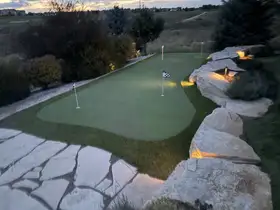
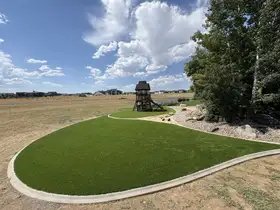
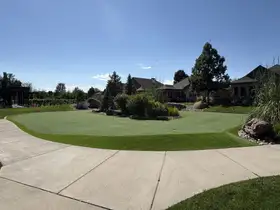
That doesn’t rule turf out of a Denver commercial project. It means turf has to be planned for the parts of the site that aren’t doing the work of meeting the required landscaped area — a courtyard amenity, a putting green tied to the primary use, or ground outside any build-to range or setback. Settling that distinction before the layout is drawn saves a redesign later.
Colorado’s statewide functional-turf law is a separate, earlier question that a commercial project also has to clear; our Colorado turf law guide covers what that state statute allows. This article is about the layer under it: what Denver’s own zoning code and green code require on top of state law, and where those two sit apart from the metro-wide comparison in our Denver-metro city turf codes guide, which covers seven cities but doesn’t include Denver’s own code in detail.
What the zoning code requires, section by section
Required open area is landscaped, and half of it must be live. Section 10.5.4.2 requires all “open areas” within a required build-to range along the applicable street frontage, and all open areas within a required minimum setback, to be landscaped. At least 50 percent of that applicable area must be live plant material; the remaining half may be live or non-live material meeting Section 10.5.4.6. “Open area” is defined by exclusion: it doesn’t include buildings, allowed encroachments, required pedestrian connections and walkways, surface parking, or areas other city laws require kept free of live planting.
Live plant material includes turf or sod — the living kind. Section 10.5.4.6 lists what qualifies: deciduous, ornamental and evergreen trees at minimum sizes, shrubs, vines and ornamental grasses, ground cover, “turf or sod,” and other similar-quality live material. All of it must be continuously maintained in a live and growing condition, and coverage is calculated at plant maturity. The section then lists non-live material separately: organic mulch, or gravel or stone designed or placed to allow permeability. Two lists, and artificial turf isn’t named on either.
A reserved frontage area for phased development carries its own 50 percent rule. Section 10.3.3.4 applies when a multi-building site develops in phases and an early phase won’t yet meet the build-to or street-activation standards. The applicant must reserve the entire street frontage, at least 60 feet deep, free of parking and utilities, and improve that reserved area with at least 50 percent live landscape material under 10.5.4.6 — the same live-material standard, applied to a temporary condition rather than a finished building line.
A permanent outdoor amenity may fall outside the open area calculation. 10.5.4.2’s definition of open area excludes “area dedicated to permanent outdoor amenities related to the primary use, such as an outdoor eating and serving area.” That’s the door a commercial turf amenity — a putting green tied to a hospitality use, for example — might walk through, but the code gives one example (outdoor dining) and doesn’t name turf. Confirm with the Zoning Administrator whether your specific amenity qualifies before you count on the exclusion.
What the Denver Green Code adds, for the projects it covers
Denver’s zoning code isn’t the only layer. The 2022 Denver Green Code, which amends the International Green Construction Code for the city, sets separate site requirements in Chapter 5 for the new construction and major renovation projects it covers. Section 501.3.3.3 requires a minimum of 20 percent of the site to be developed or retained as vegetated area. Section 501.3.3.5 requires that any new living turfgrass installed serve as functional, actively used turf rather than purely decorative grass — echoing the same “functional turf” concept behind Colorado’s statewide law, but written into Denver’s own construction code for the projects it reaches.
Whether Chapter 5 applies to a given commercial scope of work is a threshold question for the project’s code official, not something to assume either way. If it does apply, the vegetated-area and functional-turfgrass requirements sit on top of the zoning code’s landscaping and material standards above, not in place of them.
What a professional install plans around
Once the zoning picture is clear, a custom commercial turf layout still has to answer the same questions the zoning code and the reviewing official will ask:
- Where the required landscaped open area actually falls — build-to ranges, setbacks, and any reserved frontage — and what has to be live plant material there under 10.5.4.6.
- Where a turf amenity can go instead — an area tied to the primary use, outside the open area calculation, confirmed with the Zoning Administrator rather than assumed.
- Whether the Denver Green Code’s Chapter 5 applies to the scope of work, and if so, how the 20 percent vegetated-area figure and the functional-turfgrass standard fit the rest of the site plan.
On the free visit, we measure the site and check the ground, then draw a custom layout you approve before anything is ordered. Bringing your zoning determination and any Green Code applicability finding to that visit means the layout we draw is the one that can go straight to review.
Questions to settle before the project is final
- What zone district and building form apply to your site, and which open area standard — 10.5.4.2 or another section of Division 10.5 — governs your landscaping requirement?
- Where do your build-to ranges and required setbacks actually fall, and how much of that area has to carry live plant material?
- Does any part of the site qualify as a permanent outdoor amenity excluded from open area, and has the Zoning Administrator confirmed it in writing?
- Does the Denver Green Code’s Chapter 5 apply to your project, and if so, does your plan meet both the 20 percent vegetated-area figure and the functional-turfgrass standard?
- Does the site sit in Denver proper, where these code sections apply directly, or in a neighboring city with its own separate rules?
Before you finalize the layout
- Pull your zone district and confirm which landscaping subsection of Division 10.5 applies to your building form.
- Map the required open area — build-to ranges and setbacks — against your site plan.
- Ask the Zoning Administrator, in writing, whether any turf amenity you’re planning falls inside or outside that open area.
- Confirm with your project’s code official whether the Denver Green Code’s Chapter 5 applies to your scope of work.
- Bring both answers to your free visit, and we’ll build the layout around the ground the code actually leaves open for turf. Reach us at 303-349-2368 to set it up.
Common questions
Does Denver's zoning code even mention artificial turf?
Not by name. Denver Zoning Code 10.5.4.6 names what counts as live plant material (including turf or sod) and what counts as non-live material (organic mulch, or permeable gravel or stone). Artificial turf isn't on either list, so the code is silent on it rather than permitting it.
How much of my site actually has to be landscaped?
It depends on the zone district and the applicable open area. Under 10.5.4.2, the open areas inside a required build-to range or a required minimum setback must be landscaped, with at least 50 percent of that area in live plant material and the rest in live or non-live material meeting 10.5.4.6. Confirm your build-to range and setbacks with Community Planning and Development for your specific zone lot.
Can an outdoor amenity area, like a putting green, sit outside that landscaping requirement?
Possibly. 10.5.4.2's definition of open area excludes areas "dedicated to permanent outdoor amenities related to the primary use, such as an outdoor eating and serving area." Whether a turf amenity qualifies is a site-specific question. Ask the Zoning Administrator before you count on it.
Does the Denver Green Code add a separate landscaping requirement?
For projects it covers, yes, and on a different basis. Chapter 5 of the 2022 Denver Green Code requires at least 20 percent of the site to be vegetated area, and any new living turfgrass installed must serve as functional, actively used turf rather than purely decorative grass. Confirm with your project's code official whether Chapter 5 applies to your scope of work.
Who has the final say on whether a design meets these standards?
Denver's Zoning Administrator interprets and applies the zoning code's landscaping standards, and the applicable building or green code official reviews compliance with the Denver Green Code. Bring your site plan to them before ordering materials, not after.