Lawns
Artificial turf or xeriscape for a Denver yard?
The short answer
Artificial turf or xeriscape for a Denver yard?
Xeriscape is a landscape approach using appropriate plants, efficient watering and practical lawn areas. Artificial turf is a manufactured surface for a particular use. A yard can combine them, with turf where its function is useful and planting elsewhere. Both need planning and ongoing care.
They solve different problems
Xeriscape and artificial turf both get you off the sprinkler, which is why they get compared. But they do different jobs.
- Xeriscape is a way of planting. Drought-tolerant plants, mulch, efficient watering, and lawn only where you actually use it.
- Artificial turf is a surface. It needs no irrigation for growth; choose a system for the activities you want, and plan its cleaning and care.
So the useful question is not which one wins. It is which parts of your yard need a surface, and which parts could be planted.
What xeriscape actually is
The word is a Denver word. Denver Water coined it in 1981, from “landscape” and the Greek “xeros”, meaning dry. Today it calls its version ColoradoScaping.
Colorado State University Extension lists seven principles:
- Plan your design
- Improve your soil
- Irrigate efficiently
- Use drought-tolerant plants
- Limit turfgrass
- Use mulch
- Maintain your landscape
Notice number five says limit, not remove. Colorado’s own legal definition of xeriscape includes “use of practical turf areas”. A well-planned xeriscape often keeps a patch of lawn where people use it.
Where artificial turf fits, and where it doesn’t
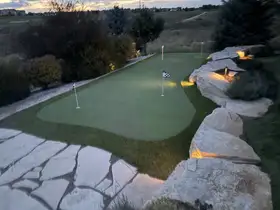
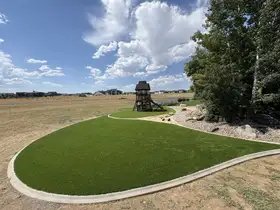
Turf covers the part of the yard that has to be walked on, played on or looked at as green. It needs no irrigation for growth. Product choice, site preparation, use and care still affect how it holds up.
It is not xeriscape, though, and Colorado law treats it that way. The statute behind the state’s Turf Replacement Program bars grant money from paying to replace grass with artificial turf, as the Colorado Water Conservation Board sets out. That program has stopped taking applications in any case.
CSU’s John Murgel names the trade-offs plainly. Artificial turf can get very hot, needs water to cool down and to clean, and eventually ends up in a landfill. All three are real, and you should plan for them:
- Heat. Put turf where it gets afternoon shade if people will be on it barefoot, and keep a hose handy.
- Cleaning. Pet areas need a rinse. Most other turf needs only an occasional one.
- End of life. Buy turf that will last, and put it where it earns its keep.
Water: both cut the lawn off the schedule
Both options take a thirsty bluegrass lawn off Denver’s watering calendar. That calendar is tight this year. Under Denver Water’s Stage 1 drought rules, lawns get two assigned days a week, and its board has ended lawn watering for the season after 30 September.
Resource Central, which runs lawn replacement for more than thirty Front Range water providers, counts about 10 gallons saved per square foot of lawn converted each year.
The difference is what is left to water. A xeriscape still needs some water, especially while plants establish, delivered efficiently by drip. Turf needs none to stay green, only the occasional rinse.
Rebates: the biggest practical difference
This is where the two part ways. Denver-metro water providers pay for xeriscape and almost never for turf:
- Aurora Water pays $3.00 a square foot for a water-wise landscape, requires at least 50% living plant cover, and lists artificial turf as prohibited.
- Castle Rock Water pays $3.25 a square foot for low-water ColoradoScape, and says artificial turf does not qualify for any part of the rebate.
- Resource Central’s program requires project areas to be replaced with at least 50% waterwise plants.
- Thornton is the exception. It pays up to $2 a square foot for artificial turf, capped at $2,000 per lot, under a written set of rules that includes a permit first and limits on front-yard coverage.
Check the calendar too. Resource Central has closed its 2026 applications, and several providers’ 2026 money is gone. Our Denver-metro rebate guide goes provider by provider.
HOA rules protect both, in the back yard
Colorado law protects both choices from a flat HOA ban. Under C.R.S. 37-60-126, a covenant or rule that prohibits or limits xeriscape, or prohibits nonvegetative turf grass in a back yard, is unenforceable.
For detached homes, SB23-178 adds more for xeriscape: the association must allow an option of at least 80% drought-tolerant plantings, and must preapprove at least three front-yard garden designs. The turf protection stops at the back yard. Our guide to Colorado HOA turf rules covers the front-yard question.
Upkeep: different, not zero
Neither is maintenance-free. CSU says a xeriscape trades weekly mowing for cutting perennials back once a year, plus weeding and checking the drip system. Turf needs brushing, clearing leaves and rinsing where pets go.
The bigger difference is use. Kids and dogs can’t play on a planting bed, and you can’t practice putting on gravel.
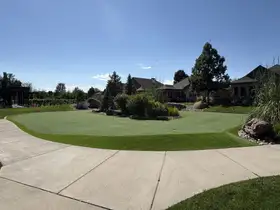
Mixing them on Denver clay
Many yards here end up with turf in the middle and xeriscape around the edges. A few ground rules from the Colorado Geological Survey apply to both, because swelling clay is common here:
- Slope the ground away from the house. CGS recommends a 10% fall within the first 10 feet of the foundation.
- Skip plastic sheeting under rock or mulch. CGS says it traps moisture. Non-woven fabric controls weeds and still lets the soil breathe.
How to decide, area by area
- Mark where people and pets actually go. Those are turf candidates.
- Mark the edges, slopes and strips nobody walks on. Those are xeriscape candidates.
- Check your water provider’s rebate rules before you design, not after.
- Put turf where it gets some afternoon shade if it will be used barefoot.
- Send the plan to your HOA in writing if you have one.
On the free visit we measure the space and check the ground, and we can walk the yard with you to decide where turf earns its place and where planting makes more sense.
Common questions
Does artificial turf count as xeriscape in Colorado?
Not for the state's purposes. The statute behind Colorado's Turf Replacement Program bars grant money from paying to replace grass with artificial turf, as the Colorado Water Conservation Board sets out. Xeriscape's seven principles are built around plants, soil and water, and turf is none of those.
Will my water provider pay me to xeriscape?
Often, when there is money left. Aurora Water pays $3.00 a square foot for a water-wise landscape, but requires at least half living plant cover and lists artificial turf as prohibited. Many 2026 programs are already full, including Resource Central's.
Can my HOA stop me from xeriscaping or putting turf in the back yard?
Not with a flat ban. Under C.R.S. 37-60-126, an HOA rule that prohibits or limits xeriscape, or prohibits nonvegetative turf grass in a back yard, is unenforceable. Front yards are treated differently, so send your plan to the board in writing.
Does xeriscape mean rocks and no lawn?
No. Colorado State University lists limiting turfgrass as one of the seven principles, not removing it. Colorado's legal definition of xeriscape includes the use of practical turf areas. Gravel mulch is one option among several.