Costs and planning
Polyethylene, nylon or polypropylene turf: which fiber?
The short answer
Which is better for artificial turf, polyethylene, nylon or polypropylene?
None wins on the label alone. The Synthetic Turf Council, the industry’s trade association, says all three can provide strength, softness, color retention and UV resistance, and warns against unsupported claims about one polymer. Pick a product made for your use, whether that is a lawn, a dog yard or a putting green. Then ask for independent lab results on UV weathering and a statement on heavy metals such as lead.
All three can work
Turf blades are plastic. New Jersey’s Department of Environmental Protection lists the fiber materials as polyethylene, nylon or polypropylene. First-generation synthetic turf, it notes, was a short nylon pile carpet laid over compacted soil.
Sales pages often rank the three, sometimes down to exact percentages. The Synthetic Turf Council, the industry’s trade association, takes a different line. Its buying guide for landscape turf tells you to “beware of unsupported claims against a certain yarn polymer type.” It says all three polymers can provide:
- strength and durability
- elastic recovery, the way a blade springs back
- softness
- color retention
- resistance to moisture and to holding odors
- UV resistance
- resistance to stains and chemicals, such as oils, saltwater and chlorinated pool water at safe concentrations
That guide dates from September 2013. It is still the plainest written caution we know of against choosing turf by polymer name.
Why the label tells you so little
Two products made from the same polymer can behave very differently. The difference is in how the fiber is made and what goes into the plastic.
Shape. The New Jersey report describes two kinds of fiber. Monofilaments are individual blades. Slit film is a sheet sliced into blades that stay attached in bundles.
Size, in different units. The trade association’s specification guidelines, last revised in November 2011, give typical minimum fiber sizes:
- polypropylene: 50 microns
- slit-film polyethylene: 100 microns
- monofilament polyethylene: 140 to 300 microns, depending on shape
- nylon: 500 denier
Nylon is rated in denier and the other two in microns. So a nylon spec sheet and a polyethylene spec sheet don’t compare line for line.
What protects it from the sun. The New Jersey report says ultraviolet radiation breaks down the molecular structure of turf fibers. Additives change how fast. A UN Environment Programme panel reports that high-density polyethylene with no UV stabiliser turned brittle within 300 hours of accelerated exposure. With a UV absorber and light stabilisers combined, it showed little degradation up to 1,300 hours. Same polymer, very different result.
The New Jersey report adds that coatings on turf fibers can improve durability against UV and wear.
Ask for test results, not adjectives
Since the name doesn’t settle it, the trade association points you to numbers. Its landscape guide lists yarn properties that should be confirmed in a report from an independent test lab:
- Color after sun. Better than Gray Scale 3 after 3,000 hours of UVA testing (ASTM D2616-12).
- Strength after sun. A loss of no more than 50% in tensile strength after 3,000 hours of UVA testing (FIFA/EN 13864).
- Yarn bulk. 8,000 total denier per bundle (ASTM D1577 and D1907).
- Heavy metals. Lead, cadmium, chromium, mercury, zinc and tin in the yarn, compliant with state and ASTM International standards.
The guide calls these minimums for landscape lawns, not a promise of performance. Some good products fall outside them and some exceed them. Still, a seller who can show you the report is giving you more than one who only names the polymer.
It also suggests you keep the sample you choose and compare it with the product delivered.
Lead: what the record shows
Lead in turf has been traced to color. In July 2008 the Consumer Product Safety Commission said lead is present in the pigments of some synthetic turf products. Its staff found:
- newer fields had no lead or generally the lowest lead levels
- some older fields had small amounts on the surface, but none released amounts harmful to children
- age, weathering, sunlight and wear might change how much lead is released
It asked for voluntary standards to keep lead out of future turf, and recommended that young children wash their hands after playing outside, especially before eating.
Seventeen years later, the New Jersey report still says detectable lead has been found in synthetic turf because lead-based pigments are used in making it. It also says information on chemicals from turf fibers is limited, and the numbers vary widely. One polyethylene fiber sample from New York held 2.8 mg/kg of lead. A separate study of samples straight from a manufacturing facility found 2,530 to 4,400 mg/kg.
Neither source says lead belongs to one fiber type. So ask about the product you’re buying: what did its heavy-metal test show?
Lawn, pets or a putting green
A lawn. The trade association’s landscape guide is written for residential, commercial and municipal lawns, so the test list above fits directly. If you have Low-E windows facing the turf, note one caution. The same guide reports random instances of polyethylene fibers shrinking and melting from reflected heat. Our article on window reflections covers how to check your yard.
A dog yard. The guide says its guidelines may not apply to pet uses such as dog runs. It also says all three polymers can resist moisture and holding odors. So the fiber name won’t answer an odor question on its own. Ask whether the product is made for pets and how water moves through the backing.
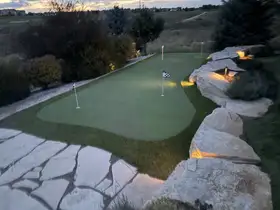
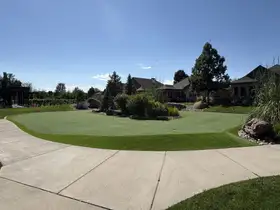
A putting green. The landscape guide says it may not apply to putting greens either. The trade association’s specification guidelines, a document written mostly with sports fields in mind, list polyethylene, polypropylene, nylon 6 or nylon 6.6 for short-pile turf, and say knitted turf typically uses nylon. On paper, no single polymer is required. Ask what the product was built and tested for, and roll a ball across a sample. For a backyard putting green, we draw a custom layout on the free visit, and you approve it before any work starts.
Checklist before you choose a fiber
Put the answers in writing, alongside the rest of what a turf quote should include.
- Name the use. Lawn, dog yard or putting green, and confirm the product is made for it.
- Ask what the fiber is, and whether it is monofilament or slit film.
- Ask for independent lab results for color and strength after 3,000 hours of UV testing.
- Ask for heavy-metal results that cover lead.
- Ask for the evidence behind any claim that one polymer beats the others.
- Keep your sample and compare it with the rolls that arrive.
- Check reflections from Low-E windows on a hot, sunny day before the layout is final.
Common questions
Is nylon turf the right choice for a putting green?
Not on the fiber name alone. The Synthetic Turf Council’s landscape buying guide says its guidelines may not apply to putting greens. Its specification guidelines list polyethylene, polypropylene or nylon for short-pile turf. Ask what the product was made and tested for, and roll a ball on a sample.
Does polyethylene turf melt?
It can under concentrated heat. The Synthetic Turf Council reports random instances of polyethylene fibers shrinking and melting from reflected heat, particularly off Low-E glass. It suggests visiting the site in the middle of a hot, sunny day to see where the reflections land.
Is there lead in artificial turf fibers?
Some products have had it. In July 2008 the Consumer Product Safety Commission said lead is present in the pigments of some synthetic turf, and that newer fields had no lead or generally the lowest levels. New Jersey’s environment department still reported lead-based pigments in October 2025. Ask for the product’s heavy-metal test results.
Which fiber should you pick for a dog yard?
The polymer alone will not settle it. The Synthetic Turf Council says all three can resist moisture and resist holding odors, and that its landscape guidelines may not apply to dog runs. Ask whether the product is made for pet use and how water drains through it.