Heat and safety
How Much Room a Backyard Golf Net or Hitting Bay Needs
The short answer
How much space does a backyard golf net or hitting bay need?
Match the space to the net and mat you're buying, not the other way around. A setup guide from one net manufacturer puts roughly 5 to 10 feet between mat and net for a full swing, about 14 feet of total room length once you add space behind the net and behind the golfer, and its widest full-size frame at about 10 feet across, with roughly 12 feet of room width recommended around it, with overhead clearance well above head height for a full driver swing. Check the exact figures for your model before the layout is final, then point the line of fire at open lawn, not the house, a neighbor's yard or a pool.
Size the space to the net, not the other way around
A golf net or hitting bay only works if the ball stays inside it. That starts with a decision, not a purchase: pick the net and mat first, get its actual footprint and clearance numbers, and let those numbers decide where it fits in the yard — not a guess at how much room “feels” right.
Nets vary enough by model that a single rule of thumb undersells some yards and oversells others. As a starting range, a setup guide published by one net manufacturer puts roughly 5 to 10 feet between the mat and the net for a full swing, and about 14 feet of total room length once you add space behind the net and space behind the golfer. Its widest full-size frame runs about 10 feet across, with roughly 12 feet of room width recommended around it. Smaller chipping and short-game nets need less. Whichever net you’re considering, its own spec sheet is the number to plan around, because bracing, side panels and net depth all change the real footprint.
Overhead clearance matters as much as depth
A driver swing travels higher than most people expect, and the ball can climb steeply off a mishit. The same manufacturer guide puts 9 to 10 feet of ceiling height as the comfort zone for a full driver swing, with anything under 8 feet workable mainly for wedges and shorter irons. Its recommendation is a buffer of 6 to 9 inches between the highest point of the swing and the lowest obstruction above it.
That guidance is written with an indoor ceiling in mind, but the same buffer belongs outdoors too. A patio cover, a gutter line, a second-story eave or a low tree limb can end a full swing just as fast as a garage ceiling. Walk the space and look up before the layout is set, not after the net is staked in.
Point the line of fire somewhere safe
Every net has a front and a back, and a mishit can clear either side of it. Before you settle on a spot, trace where a ball would go if it missed the net entirely:
- Toward the house. Windows, siding and screens are the most common casualties of a backyard net setup.
- Toward a neighbor’s yard or the street. A fence helps, but a net angled toward a property line puts more shots near it.
- Toward a pool or pool cage. Screen enclosures don’t stop a golf ball.
- Into open lawn. The safest direction, and usually the one with the most room to work with.
Leave real distance behind the net, too — not just beside it — for the ball to lose speed before it reaches whatever is back there.
What one Jacksonville-area community requires
Sports netting isn’t only a layout question in some communities; it’s a written one. The St. Johns Golf & Country Club’s own ARC guidelines group “sports netting” with other portable play equipment — a category that also names swimming pools, plastic swing sets, sliding boards, skateboard ramps and plastic basketball hoops. The rule for all of it: removed from yards and driveways, and stored inside when not in use.
That guideline is dated to a 2010 revision. Associations update their documents, so confirm the current text with your own community before you plan a layout around it — don’t rely on an older copy, including this one. If you’re near World Golf Village or Glen Kernan Golf & Country Club, check with your own association directly; each sets its own rules, and they don’t share one policy just because they’re both golf communities.
What a professional install handles
We don’t sell or erect the net — that’s a separate purchase you make and set up, or have a net installer handle. What we install is the ground it sits on and the turf around it.
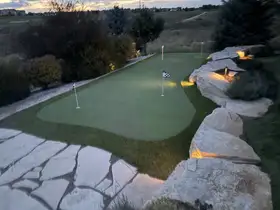
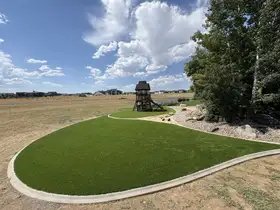
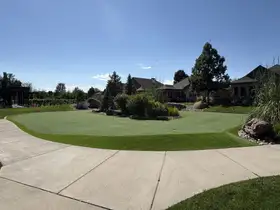
On the free visit, we measure the space and check the ground, the same way we would for any other part of the yard. A hitting bay takes repeated, concentrated impact from mat and footwork in one small footprint, different from a lawn that only gets walked on, so the base underneath needs to be built for that. We put together a custom layout you approve before anything starts, prep the site, build the base for your soil, then lay, seam and edge the turf and finish with infill and cleanup. If a putting green is part of the same project, we lay out both together so the hitting bay and the green share the yard without one crowding the other.
Questions to settle before the layout is final
- What footprint does your specific net and mat need? Length, width and overhead clearance all come from the model’s own spec sheet, not a general estimate.
- Where does a mishit go? Trace the line past the net, not just the space in front of it.
- Does your community regulate sports netting or portable play equipment? Get the current guidelines in writing from your association before you plan around an older copy.
- Is a putting green going in at the same time? Decide the shots you want from each feature before you decide how close together they sit.
- What’s under the surface? Irrigation heads, drainage lines and tree roots can all move where the base should go.
Call us at 303-349-2368, or start with the free visit — we’ll measure the space, check the ground, and draw a layout you approve before anything is dug.
Common questions
How much overhead clearance does a golf net need?
More than most garages or covered patios give you. A setup guide published by one net manufacturer puts 9 to 10 feet of ceiling height as the comfort zone for a full driver swing, with a buffer of 6 to 9 inches between the top of your swing and the lowest obstruction above it. Outdoors, that same buffer applies to gutters, eaves and low tree limbs, not just a ceiling.
How far should a golf net sit from the hitting mat?
Check the spec sheet for the net you're buying — the distance changes by model and by how the frame is braced. Whatever figure it gives you, treat it as a minimum, not a target, and leave extra room behind the net for the ball to lose speed before it reaches a fence, wall or planting bed.
Can an HOA regulate a golf net or hitting screen?
Some can. The St. Johns Golf & Country Club's own ARC guidelines list sports netting under portable play equipment, alongside items such as plastic basketball hoops and plastic swing sets, and require it "removed from yards and driveways" and "stored inside when not in use." Get the current guidelines from your own association before you plan around them — a community's rules can change after the date a document was posted.
Can a golf net share the yard with a putting green?
Yes, and many people set them up together. The trade-off is usually walking room: a net and mat set close to a green can crowd the approach shots you'd otherwise chip in from. Decide the shots you want to practice first, then let that decide how the net, the mat and the green are arranged relative to each other.
Does a hitting bay need its own base under the turf?
The ground under a net and mat setup takes repeated, concentrated impact in one small footprint, different from a lawn used for walking. We check the ground on the free visit and build the base for what that spot will actually take, as part of the same layout as the rest of your turf.